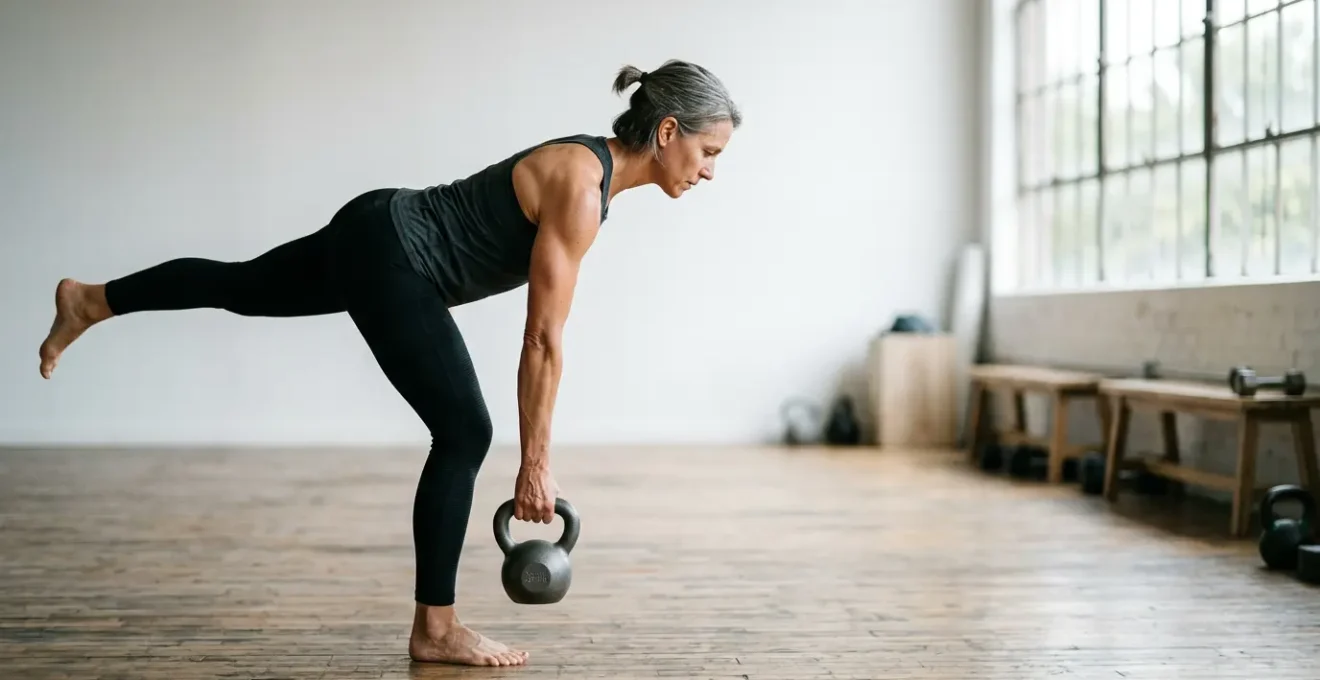
The common wisdom that you must choose between being strong or being mobile after 40 is a myth; the key is to build strength *through* your full range of motion.
- Traditional lifting in limited ranges (like bench press) can increase muscle stiffness and risk of injury.
- Integrating mobility work *into* your strength sessions with loaded stretches and full-range movements builds usable, real-world strength.
Recommendation: Stop treating strength and mobility as separate goals. Start training movement patterns that build “strength through length” to make daily activities feel effortless and protect your joints for the long haul.
As an athlete over 40, you’ve likely noticed a frustrating paradox. You can hit your numbers in the gym, your bench press is solid, your leg press is heavy, yet you feel a creeping stiffness in your shoulders during your golf swing, or your back aches after an hour of gardening. You’re strong, but you’re not mobile. The standard advice is often to just “stretch more” or add a separate yoga day, treating mobility as an afterthought to your “real” training. This approach is fundamentally flawed.
This compartmentalization is the very thing holding you back. It creates “gym strength” that doesn’t translate to the real world and, worse, can lead to injury. The true key to functional longevity isn’t building more strength *or* more mobility; it’s about developing them together. It’s about building what I call ‘Strength Through Length’—the capacity to be strong, stable, and powerful through the entire arc of a movement.
This guide will deconstruct why your current training might be working against you. We will explore the biomechanical traps many seasoned athletes fall into and provide a clear, actionable framework to reprogram your workouts. You will learn not just to lift, but to move, building a resilient body that feels as good in daily life as it performs in the gym.
This article will guide you through the essential principles and practical applications for integrating strength and mobility. From deconstructing common exercises to structuring your workouts, we’ll build a complete roadmap for your long-term athletic journey.
Summary: How to Build Strength That Actually Improves Your Mobility After 40?
- Why Your Bench Press Is Ruining Your Shoulder Mobility for Golf?
- How to Structure a 45-Minute Session That Builds Muscle and Range of Motion?
- Yoga vs. Functional Mobility: Which Prevents Back Pain for Heavy Lifters?
- The Stiffness Trap: How Strong Muscles Snap Tendons in Older Adults
- Which 3 Loaded Stretches Will Unlock Your Hips in 30 Days?
- Why Your Leg Press Strength Doesn’t Help You Climb Stairs?
- Why Morning Stiffness Disappears After 10 Minutes of Movement?
- How to Use Functional Resistance Training to Make Daily Chores Effortless?
Why Your Bench Press Is Ruining Your Shoulder Mobility for Golf?
The bench press is a staple of strength, but for the aging athlete with specific movement goals like a fluid golf swing, it can be a primary source of dysfunction. The exercise locks your shoulder blades (scapula) against a bench, forcing the small rotator cuff muscles and shoulder joint to manage immense force in a fixed, unnatural path. This is the opposite of how your shoulder is designed to move for rotational activities like throwing or swinging a club, which require the scapula to glide freely.
The result is a progressive increase in shoulder stiffness. As one case study on female rugby players showed, higher bench press performance directly correlated with increased shoulder stiffness. You’re building strength in a very narrow window of movement, while the surrounding tissue shortens and tightens to “protect” the joint. This creates a powerful but ‘brittle’ shoulder, ill-equipped for the dynamic, full-range demands of a golf swing.
The technique itself is a major factor. A 2024 biomechanical study that tested 21 technical variations of the bench press highlighted how subtle changes in grip, elbow position, and bar path dramatically alter the loads on the shoulder joint. Without expert coaching tailored for mobility, most lifters adopt a technique that prioritizes moving maximum weight over joint health, inadvertently training their body into a state of stiffness that sabotages their athletic performance outside the gym.
Ultimately, to protect your golf swing, you don’t have to abandon pressing, but you must shift the focus from pure load to movement quality, incorporating push-up variations and dumbbell presses that allow the shoulder blade to move naturally.
How to Structure a 45-Minute Session That Builds Muscle and Range of Motion?
The key to building both strength and mobility in a single session is efficiency and integration. Forget spending 30 minutes lifting, then 15 minutes on mindless stretching. The goal is to make every movement count by choosing exercises that challenge your muscles through their full, available range. A well-structured 45-minute session should feel like a coordinated dance between tension and release.
A highly effective method is the “superset” or “paired set” approach. You pair a traditional strength movement with a mobility drill that targets the same area. For example, after a set of heavy goblet squats where you focus on deep, controlled descent, you immediately perform a set of “hip CARs” (Controlled Articular Rotations) to actively explore and lubricate the hip joint. The strength exercise creates the stimulus for muscle growth and fatigues the primary movers, allowing you to access a deeper range of motion in the follow-up mobility drill.
Your workout should be built around fundamental human movement patterns: a squat, a hinge, a push, a pull, and a carry. Within each, you prioritize Strength Through Length. This means using a weight that allows you to maintain perfect form through a full range of motion, rather than sacrificing range for a heavier load. The bottom of a squat or the full stretch of a dumbbell row becomes an opportunity not just to lift, but to lengthen and strengthen tissue at its end range.
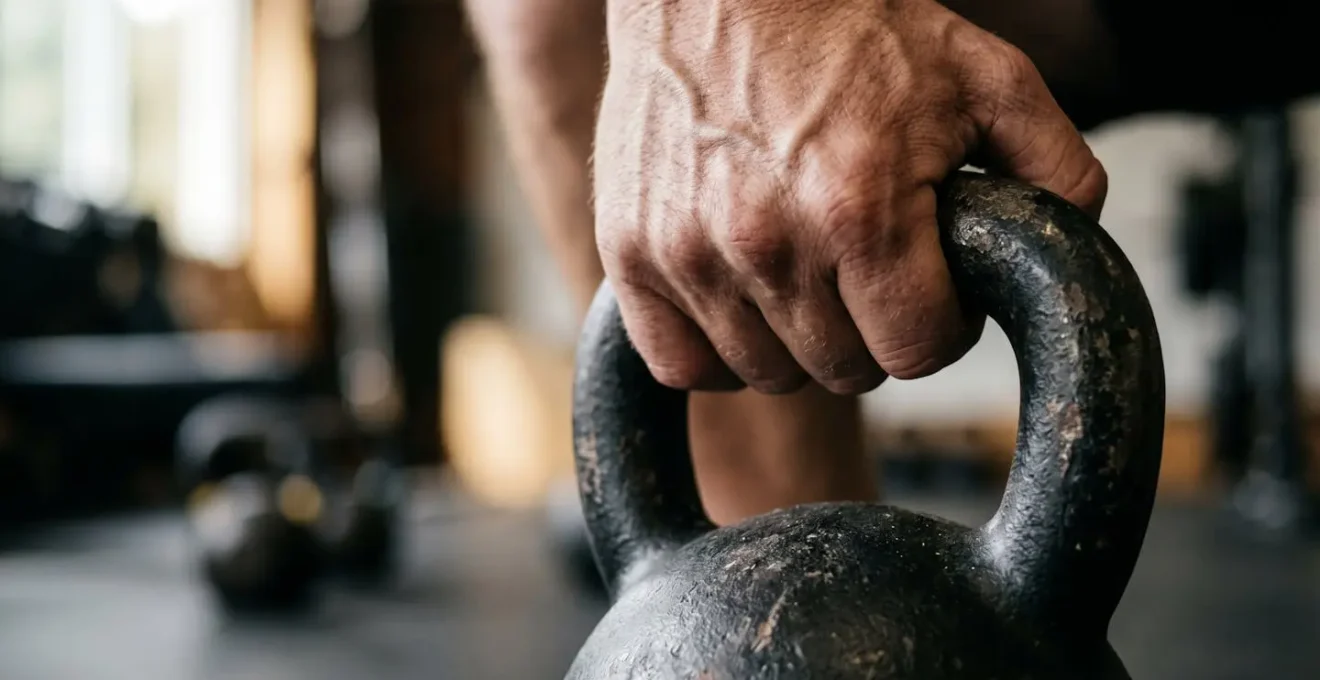
As seen in the image, even a simple movement like the goblet squat becomes a potent mobility tool when you focus on the details: keeping the chest up, actively using your elbows to pry the knees open at the bottom, and feeling the stretch in your hips and groin. This active, loaded position is far more valuable than any passive stretch done cold at the end of a workout.
Your 5-Point Integrated Session Audit
- Dynamic Warm-up: Does your warm-up actively mimic the main movements of the day (e.g., bodyweight squats before weighted squats)?
- Paired Movements: Are you pairing a primary strength exercise with a mobility drill for the same joint or opposing muscle group?
- Full Range of Motion: Is every rep performed with control through the maximum safe range of motion, not just to move the weight?
- Unilateral Work: Does your session include at least one single-leg or single-arm exercise to identify and correct strength imbalances?
- Loaded Carry: Does your workout conclude with some form of loaded carry (e.g., Farmer’s Walk) to integrate full-body stability and core tension under load?
This integrated approach not only saves time but also teaches your nervous system that strength and mobility are one and the same, creating a more resilient and capable body.
Yoga vs. Functional Mobility: Which Prevents Back Pain for Heavy Lifters?
For heavy lifters battling back pain, both yoga and functional mobility drills are often recommended, but they address the problem from different angles. It’s crucial to understand their distinctions to choose the right tool for the job. Yoga, an ancient practice, offers immense benefits, particularly in improving body awareness, reducing stress, and increasing passive flexibility. However, for a powerlifter or strongman, its primary benefit might be more neurological and emotional than purely mechanical.
In fact, a 2026 systematic review and meta-analysis found that while yoga didn’t consistently outperform other active exercises for pain reduction, it did show significant benefits in other areas. As the research team from Frontiers in Medicine noted:
Yoga demonstrated statistically significant improvements in physical function and emotional wellbeing compared to active exercise interventions, while no consistent advantage was observed for pain or disability.
– Research team, Systematic review and meta-analysis on yoga vs exercise for chronic low back pain
Functional mobility, on the other hand, is a more targeted approach. It focuses on improving active, usable range of motion specific to the demands of lifting. It’s less about holding a passive stretch and more about teaching your joints to move through their full range with control and strength. For a lifter with back pain caused by immobile hips, functional mobility would involve drills like loaded goblet squats and controlled hip rotations—movements that directly teach the hips to contribute more to the lift, taking stress off the lower back. Yoga may improve hip flexibility, but functional mobility teaches you how to *use* that flexibility under load.
For the heavy lifter, the optimal strategy often involves a blend: using functional mobility drills as a core part of their warm-up and training to improve lifting mechanics, while incorporating yoga as a recovery and nervous system regulation tool to manage stress and improve overall well-being.
The Stiffness Trap: How Strong Muscles Snap Tendons in Older Adults
One of the most dangerous paradoxes for the aging athlete is the “Stiffness Trap.” This occurs when you have very strong, well-developed muscles but have neglected the mobility of your joints and the elasticity of your connective tissues, particularly your tendons. As we age, tendons naturally lose some of their water content and elasticity. When you pair this with powerful muscles that can generate immense force, and joints that can’t move through a full range to dissipate that force, you create a perfect storm for injury.
Imagine a powerful engine (your muscles) connected to a brittle, old driveshaft (your tendons). When you slam on the gas, something has to give—and it won’t be the engine. This is why we see so many non-contact Achilles, biceps, or patellar tendon ruptures in strong, active adults over 40. The muscle contracts with such force that the stiff, unprepared tendon simply cannot handle the load and snaps. It’s a direct result of building strength without concurrent mobility and tissue quality.
This problem is compounded by age-related muscle loss, or sarcopenia. According to research, 45% of older adults in the U.S. lose muscle as they age. This creates a desperate urgency to lift heavy and build muscle, often at the expense of movement quality. Athletes try to out-train the aging process with brute force, inadvertently walking themselves deeper into the stiffness trap. They build powerful muscles that are attached to a system that can no longer effectively manage that power across a variety of movements.
The antidote is not to stop lifting heavy, but to start training with the explicit goal of improving tendon health and joint range of motion. This involves slower eccentrics, loaded stretching, and ensuring your connective tissues are as well-conditioned as your muscles.
Which 3 Loaded Stretches Will Unlock Your Hips in 30 Days?
If you feel chronically tight in your hips, no amount of passive butterfly stretching is going to solve the problem. The reason you’re tight is often not because the muscles are short, but because your nervous system perceives a lack of stability and “hits the brakes” to protect you. To truly unlock your hips, you need to prove to your body that you are strong and stable in new ranges of motion. This is where loaded stretching, or ‘loaded mobility’, comes in.
Loaded stretching uses a light weight to gently pull you deeper into a position while you actively resist, building strength and control at the end of your range. It simultaneously tells your nervous system, “It’s safe to go here; we are strong here.” By training in all three planes of motion—sagittal (forward/backward), frontal (side-to-side), and transverse (rotational)—you can achieve remarkable improvements in hip mobility and function in as little as 30 days.
Here is a powerful three-exercise protocol to practice 2-3 times per week:
- Sagittal Plane: Goblet Squat with Prying: Hold a kettlebell or dumbbell at chest height. Descend into the deepest squat you can control. At the bottom, actively use your elbows to gently push your knees outward, “prying” your hips open. Hold this active bottom position for 2-3 seconds per rep, feeling your adductors lengthen while your glutes and core remain engaged. This teaches your hips deep, loaded flexion.
- Frontal Plane: Loaded Cossack Squat: Hold a light dumbbell at your chest. Shift your weight to one side, descending into a deep side lunge while keeping the trailing leg straight with the foot planted. Go as low as you can with control, feeling a strong stretch in the adductors of the straight leg. By loading this position, you build strength in this lengthened state, crucial for lateral movements.
- Transverse Plane: Landmine Hip Twists: Stand perpendicular to a barbell anchored in a landmine attachment. Hold the end of the bar at shoulder height with both hands. Keeping your arms relatively straight, perform a controlled rotation, pivoting on your feet as the bar moves across your body. This builds strength and control in both hip internal and external rotation, a critical and often-neglected component of hip health.
This protocol systematically addresses the hip’s ability to move in every direction, building the ‘Strength Through Length’ that is essential for fluid, pain-free movement.
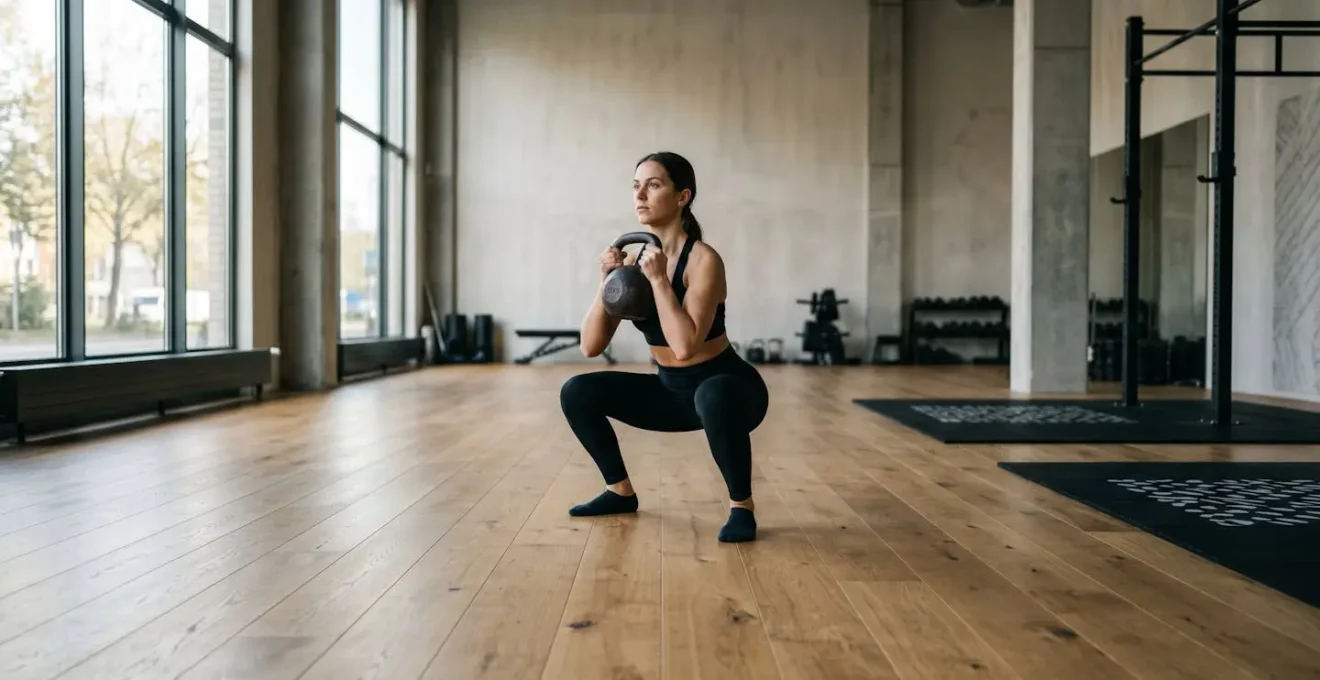
Patience and consistency with this approach will yield far greater and more permanent results than hours of passive stretching ever could.
Why Your Leg Press Strength Doesn’t Help You Climb Stairs?
It’s a common frustration: you can leg press a huge amount of weight, but a few flights of stairs leave you breathless or with achy knees. This disconnect highlights the crucial difference between isolated strength and functional capacity. The leg press machine, while effective at building quadriceps muscle mass, fails to prepare you for stair climbing for one simple reason: it removes the need for stability.
When you’re seated in a leg press, your back is supported, your core is relatively disengaged, and the machine dictates a fixed path of motion. You are only required to produce force. Climbing stairs, however, is a complex, unilateral (one-legged) activity that requires a symphony of muscular coordination. Each step demands:
- Single-leg stability: Your hip, knee, and ankle must stabilize your entire body weight on one leg.
- Core engagement: Your trunk must remain stable to transfer force efficiently from your leg to the rest of your body.
- Balance: Your nervous system is constantly making micro-adjustments to keep you upright.
The leg press trains none of these things. It creates strong legs that only know how to function when fully supported. As strength coach Judd Lienhard explains, this is where single-limb movements are essential:
Unilateral, or single-limb, movements can support strength while exposing weak links. These are muscles that maybe don’t get trained adequately if we only do bilateral lifts.
– Judd Lienhard, Strength Coach, Training rules for strength after 40 podcast
To build strength that helps you climb stairs, you must incorporate exercises like Bulgarian split squats, lunges, and step-ups. These movements challenge your stability and balance while building strength on one leg at a time, directly translating to better performance in daily life. Maintaining this functional strength is manageable within a schedule of 2 to 4 training sessions per week, which is ideal for adults over 40.
True strength is not just about how much you can push; it’s about how well you can control your own body through space.
Why Morning Stiffness Disappears After 10 Minutes of Movement?
That familiar feeling of waking up stiff as a board, only to feel progressively better after you start moving, is not just in your head. It’s a direct physiological process related to the health of your joints and the properties of something called synovial fluid. Think of synovial fluid as the oil for your body’s hinges—your joints. This viscous fluid is responsible for lubricating the cartilage surfaces, providing them with nutrients, and clearing away waste products.
When you are inactive for a long period, like during sleep, this fluid thickens and is partially reabsorbed by the surrounding tissues. The joints are essentially “cold” and under-lubricated. This is why you feel stiff. The initial movements of your day—getting out of bed, walking to the kitchen, doing a few gentle stretches—act like a pump. They stimulate the synovial membrane to produce fresh fluid and decrease the viscosity of the existing fluid, making it a more effective lubricant. This process circulates nutrients to the cartilage and flushes out inflammatory byproducts that may have accumulated overnight.
This phenomenon is a powerful demonstration of the principle “motion is lotion.” It shows that our joints are designed to move and that movement is what keeps them healthy. In fact, for those who engage in regular strength training, this effect is even more pronounced. A targeted mobility routine is shown to have significant benefits, as highlighted in one case study:
Case Study: Mobility Routine Reduces Joint Stiffness
A daily 10-15 minute mobility routine focusing on key areas like the hips, hamstrings, shoulders, and thoracic spine has been shown to reduce stiffness and improve movement quality in individuals who lift weights or spend long hours sitting. This demonstrates how targeted movement helps restore joint lubrication and function, effectively combating the stiffness caused by both intense activity and prolonged inactivity.
That 10 minutes of morning movement is not just “warming up”; it’s an essential act of joint maintenance that sets the stage for a pain-free and capable day.
Key Takeaways
- Traditional strength training often creates stiffness by ignoring strength at the end-ranges of motion.
- Integrating mobility *into* your strength session (e.g., loaded stretches, full ROM) is more effective than separating them.
- The true goal is ‘functional capacity’—strength that translates directly to effortless daily movement, not just gym numbers.
How to Use Functional Resistance Training to Make Daily Chores Effortless?
The ultimate goal of training after 40 isn’t just to look good or lift heavy; it’s to build a body that makes life easier. It’s about being able to carry all the groceries in one trip, lift your child without a second thought, or spend an afternoon gardening without a week of back pain. This is the promise of functional resistance training: training movements, not just muscles, to directly improve your “activities of daily living” (ADLs).
Instead of thinking in terms of “chest day” or “leg day,” functional training organizes workouts around the five fundamental human movement patterns: the squat, the hinge, the push, the pull, and the carry. By getting strong in these patterns, you are directly building the physical capacity required for nearly every task life throws at you. A heavy kettlebell deadlift, for example, is not just a hamstring and glute exercise; it is practice for safely picking up any heavy object from the floor, from a bag of dog food to a piece of furniture.
The table below provides a clear translation from a fundamental gym movement to the daily chores it makes easier. It reframes your workout as direct preparation for a more capable and effortless life.
| Fundamental Movement Pattern | Key Training Exercise | Daily Chores Made Easier | Primary Muscles Targeted |
|---|---|---|---|
| Hinge | Kettlebell Deadlift | Picking up groceries, lifting children, moving packages, loading laundry | Hamstrings, Glutes, Erectors |
| Squat | Goblet Squat | Getting up from low chairs, gardening, playing with kids on floor | Quads, Glutes, Core |
| Push | Push-Up Variations | Opening heavy doors, moving furniture, getting up from floor | Chest, Shoulders, Triceps |
| Pull | Dumbbell Row | Pulling weeds, opening doors, carrying bags, lifting objects onto shelves | Lats, Rhomboids, Biceps |
| Carry | Farmer’s Walk / Suitcase Carry | Carrying groceries, moving boxes, transporting tools, holding children | Grip, Core, Trapezius, Full-body stability |
This approach transforms your perception of exercise. It’s no longer a chore you have to do, but an investment that pays daily dividends in the form of physical freedom and resilience. By focusing on these patterns, you build a body that is not only strong in the gym but, more importantly, robust and capable in the real world.
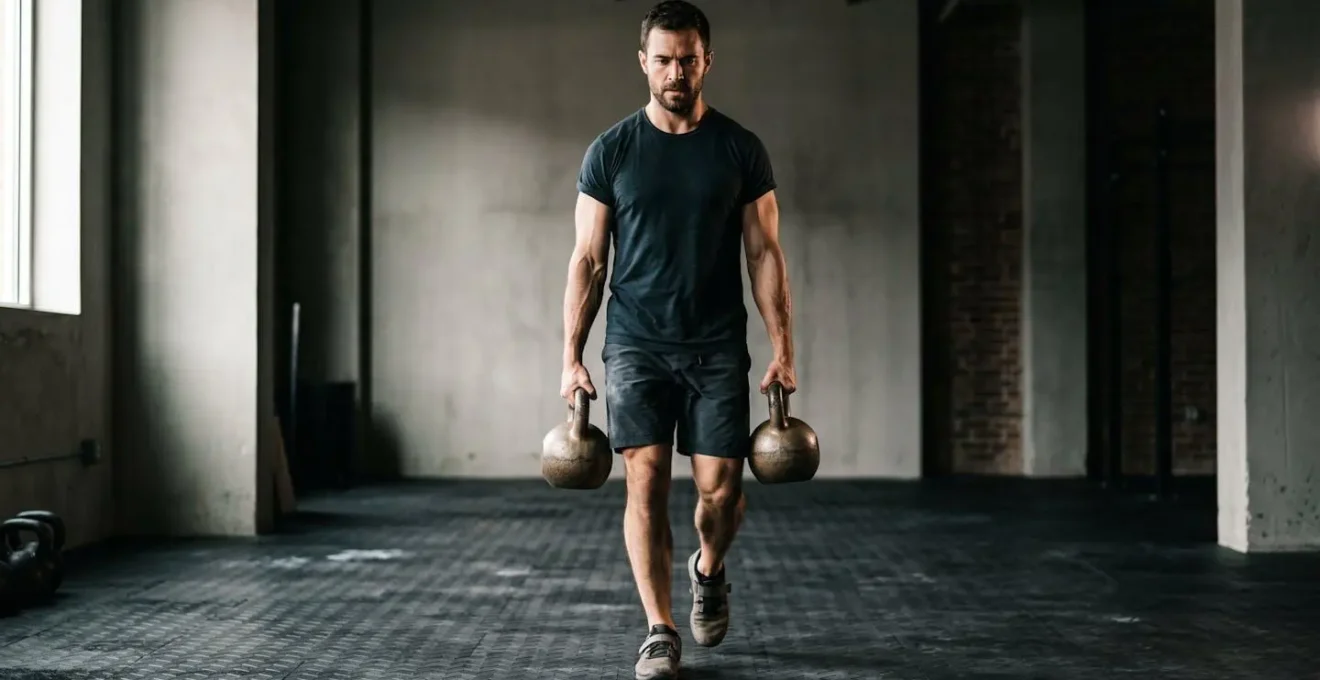
Start training for life, not just for the gym, and watch as the daily chores that used to be a strain become effortlessly manageable.