
Feeling ‘tired but wired’ is a sign your nervous system is stuck in ‘fight-or-flight’ mode, blocking restorative sleep.
- Specific techniques like resonant humming and the ‘physiological sigh’ directly stimulate the vagus nerve to command a state of calm.
- Protocols like Non-Sleep Deep Rest (NSDR) actively replenish dopamine, unlike passive screen time which can deplete it.
Recommendation: The key is to build a pre-sleep routine that methodically lowers cortisol and core body temperature, signaling to your brain that it’s safe to enter deep sleep.
You’ve had a long, demanding day. You feel a deep-seated exhaustion in your bones, yet as your head hits the pillow, your mind is racing. You’re “tired but wired,” a frustrating paradox that plagues millions. This state isn’t a personal failing; it’s a physiological signal that your autonomic nervous system is stuck in high gear. The sympathetic “fight-or-flight” system, designed for short-term threats, has remained active, preventing the parasympathetic “rest-and-digest” system from taking over to initiate deep, restorative sleep.
Most conventional advice—like reading a book or avoiding screens—scratches the surface but often fails because it doesn’t address the root biological state. The real challenge is not simply to “relax,” but to send clear, undeniable signals to your brainstem and vagus nerve to command a full system downshift. This requires more than just willpower; it demands specific, physiological tools that work with your body’s innate wiring.
But what if the key wasn’t in trying to quiet your mind, but in using your body to tell your mind it’s safe? This guide moves beyond generic tips to provide a specialist’s framework for deliberate nervous system regulation. We will explore the concrete, technique-driven methods that actively trigger the parasympathetic response, from vibrating your vagus nerve with sound to using your breath to chemically signal safety to your brain.
This article will provide a series of actionable protocols designed to dismantle the “tired but wired” state. You’ll learn how to switch modes after intense stress, why certain practices recharge your brain while others drain it, and how to build an evening ritual that guarantees your body enters its prime state for cellular restoration.
This guide is structured to give you a complete toolkit for nervous system regulation before bed. Below is a summary of the specific techniques and biological principles we will cover to help you finally achieve the deep rest you need.
Summary: A Guide to Parasympathetic Activation for Sleep
- Why Low Vagal Tone Makes It Hard to Calm Down After Work?
- How to Use Humming or Chanting to Vibrate Your Vagus Nerve?
- NSDR vs. Watching Netflix: Which Actually Recharges Your Battery?
- The “Always On” Danger: How Chronic Sympathetic Dominance Erodes Gut Health?
- How to Switch to Parasympathetic Mode Immediately After a HIIT Session?
- Which 4-7-8 Rhythm Puts You to Sleep Faster Than Melatonin?
- Sauna vs. Hot Bath: Which Heat Therapy Boosts Slow Wave Sleep?
- How to Increase Deep Sleep Percentage for Better Cellular Restoration?
Why Low Vagal Tone Makes It Hard to Calm Down After Work?
The feeling of being unable to “switch off” after a stressful workday is a direct indicator of your vagal tone. The vagus nerve is the main highway of your parasympathetic nervous system, running from your brainstem down through your neck and into your torso, connecting to your heart, lungs, and digestive tract. Think of vagal tone as the strength or responsiveness of this system. High vagal tone means your body can quickly shift from a stressed (sympathetic) state to a calm (parasympathetic) state. You can down-regulate with ease.
Conversely, low vagal tone means this regulatory muscle is weak. After a day filled with deadlines, notifications, and meetings, your sympathetic system remains dominant. Cortisol and adrenaline continue to circulate in your bloodstream, keeping your heart rate elevated and your mind alert, even when you are physically exhausted. Your body is still scanning for threats, making it biologically impossible to relax deeply or fall asleep easily.
Chronic stress, lack of physical activity, and shallow breathing all contribute to reducing vagal tone over time. This creates a vicious cycle: stress lowers your vagal tone, which in turn makes you less resilient to future stress. You become trapped in a state of hypervigilance, where the “off switch” for your stress response is difficult to find. The key to breaking this cycle is not just to avoid stress, but to actively train your vagus nerve, strengthening its ability to command calm throughout your body.
Mastering this internal switch is fundamental. To do so, you must learn the practices that directly stimulate this crucial nerve and improve its overall responsiveness, which we will explore next.
How to Use Humming or Chanting to Vibrate Your Vagus Nerve?
One of the most direct and effective ways to manually activate your vagus nerve is through mechanical vibration. Since a significant branch of the vagus nerve passes through your throat and near your vocal cords, using sound is a powerful bio-hack. Humming, chanting, or even gargling creates gentle vibrations that directly stimulate the nerve endings, sending a signal of safety and calm straight to your brainstem. This process is a form of interoception—using an internal physical sensation to consciously shift your physiological state.
This isn’t just a folk remedy; it’s backed by measurable data. In fact, a 2023 Holter-based study found that humming generates the lowest stress index when compared to physical activity, emotional stress, and even sleep itself, highlighting its profound down-regulating effect. The key is to create a low-frequency sound that generates a palpable resonance in your throat and chest.

The image above illustrates the target area for this practice. By placing your hand on your throat or chest, you can get real-time feedback and adjust the pitch of your hum to maximize the vibrational sensation. This physical feedback anchors your mind to your body, pulling you away from racing thoughts and into the present physiological moment of calm. To implement this, you can follow a simple protocol.
Resonant Frequency Humming Protocol
- Find a comfortable seated or standing position with your spine naturally erect but relaxed.
- Place one hand on your chest and one on your throat to feel the vibrations.
- Take a deep breath in through your nose for 4-5 counts.
- Exhale while creating a low-pitched ‘Vooo’ or ‘Ommm’ sound, aiming for a frequency around 120 Hz (the musical key of B).
- Focus on feeling the vibration directly in your throat and upper chest, where the vagus nerve is most accessible.
- Continue for 2-5 minutes, experimenting with pitch until you feel maximum resonance.
- Practice this during stressful moments for immediate relaxation or incorporate it into your daily routine for cumulative benefits.
NSDR vs. Watching Netflix: Which Actually Recharges Your Battery?
After a draining day, the impulse to collapse on the couch and stream a show is strong. While it feels like “switching off,” passive entertainment like watching Netflix is often neurologically stimulating. The fast-paced edits, emotional plotlines, and blue light from the screen can keep your sympathetic nervous system subtly engaged, doing little to truly recharge your mental batteries. In contrast, Non-Sleep Deep Rest (NSDR) offers a structured, science-based alternative for profound restoration.
NSDR is a term coined by Dr. Andrew Huberman of Stanford University to describe practices like yoga nidra or guided self-hypnosis. These protocols systematically guide your attention through your body and breath, intentionally steering your brain into restorative states. Unlike passive viewing, NSDR is an active rest. The goal is to reach a state of alert calmness, where the body is deeply relaxed, but the mind is lucid. This state is associated with increased alpha and theta brainwave activity—the same brainwaves dominant during meditation and light sleep.
The neurochemical difference is stark. While binge-watching can lead to a dopamine crash, leaving you feeling groggy, neuroscience research demonstrates that an NSDR session replenishes dopamine levels and decreases cortisol. This supports the optimal mental state for recovery and learning. It actively shifts your autonomic nervous system toward a parasympathetic dominant state, calming your heart rate and promoting bodily repair functions.
Case Study: Rapid Cognitive Enhancement with Daily NSDR
In a 2019 study published in Behavioral Brain Research, NYU neuroscientist Wendy Suzuki, Ph.D., reported that a mere 13-minute daily NSDR practice enhanced attention, memory, mood, and emotional regulation in subjects who did not normally practice meditation. This demonstrates that NSDR systematically guides the brain into restorative theta and alpha wave states that passive screen time cannot replicate, providing measurable cognitive benefits in a short amount of time.
Choosing NSDR over Netflix isn’t about deprivation; it’s about choosing genuine restoration over superficial distraction. A 10-to-20-minute NSDR session can leave you feeling more refreshed and clear-headed than an hour of television, making it a far more efficient tool for evening recovery.
The “Always On” Danger: How Chronic Sympathetic Dominance Erodes Gut Health?
When your body is chronically stuck in a sympathetic “fight-or-flight” state, the consequences extend far beyond poor sleep and mental fatigue. One of the most significant, yet often overlooked, areas of damage is your digestive system. The parasympathetic system governs the “rest-and-digest” functions, meaning proper digestion, nutrient absorption, and gut repair can only happen when your body is in a state of calm. When you are “always on,” these critical processes are perpetually sidelined.
This chronic stress state directly impacts the physical integrity of your gut lining. It diverts blood flow away from the digestive organs to the limbs (in preparation for fight or flight), reduces the secretion of digestive enzymes, and alters the balance of your gut microbiota. This creates a perfect storm for intestinal permeability, or “leaky gut.” In fact, a 2018 study in Frontiers in Microbiology revealed that psychological stress can increase intestinal permeability by as much as 30%. When the gut lining becomes permeable, undigested food particles and endotoxins can leak into the bloodstream, triggering systemic inflammation.
This inflammation doesn’t just stay in the gut. The gut-brain axis is a bidirectional highway, and what happens in the gut directly affects the brain. This connection is powerfully summarized by experts in the field.
The intestine and BBB [blood-brain barrier] become hyperpermeable with compromised integrity–the ‘leaky gut, leaky brain’ that can affect physical, cognitive, and mental health.
– Research team on microbiota-gut-immune-brain axis, Dangers of the chronic stress response in the context of the microbiota-gut-immune-brain axis and mental health
Therefore, managing your stress response is not just about feeling better mentally; it is an essential practice for maintaining your physical health from the inside out. Prioritizing parasympathetic activation through the techniques in this guide is a direct intervention to protect your gut lining, reduce inflammation, and support a healthy gut-brain connection, which is foundational for overall well-being.
How to Switch to Parasympathetic Mode Immediately After a HIIT Session?
High-Intensity Interval Training (HIIT) is an excellent way to improve cardiovascular health and stress resilience, but it places a massive acute demand on your sympathetic nervous system. The “tired but wired” feeling is especially common after an evening workout, as your body is flooded with cortisol and adrenaline. Without a deliberate down-regulation protocol, this heightened state can persist for hours, sabotaging your sleep. The key is to have a rapid-reset routine to manually trigger a parasympathetic rebound.
The goal is to signal to your body that the “threat” (the intense exercise) is over and it is now safe to begin recovery. This involves two main physiological levers: manipulating blood flow and controlling your breath. Immediately stopping after a final sprint can cause blood to pool in your legs, so a brief cool-down walk is essential. Following this with a “legs up the wall” pose (Viparita Karani) uses gravity to assist venous return to the heart, which has a calming effect on your nervous system.
This pose is the perfect opportunity to deploy the most powerful tool for an immediate state change: the “physiological sigh.” Popularized by Dr. Andrew Huberman, this breathing pattern consists of two sharp inhales through the nose followed by a long, extended exhale through the mouth. The double inhale re-inflates any collapsed alveoli in the lungs, maximizing gas exchange, while the long exhale is the primary trigger for slowing the heart rate via the vagus nerve. This is the fastest known way to consciously bring your body out of a sympathetic state.
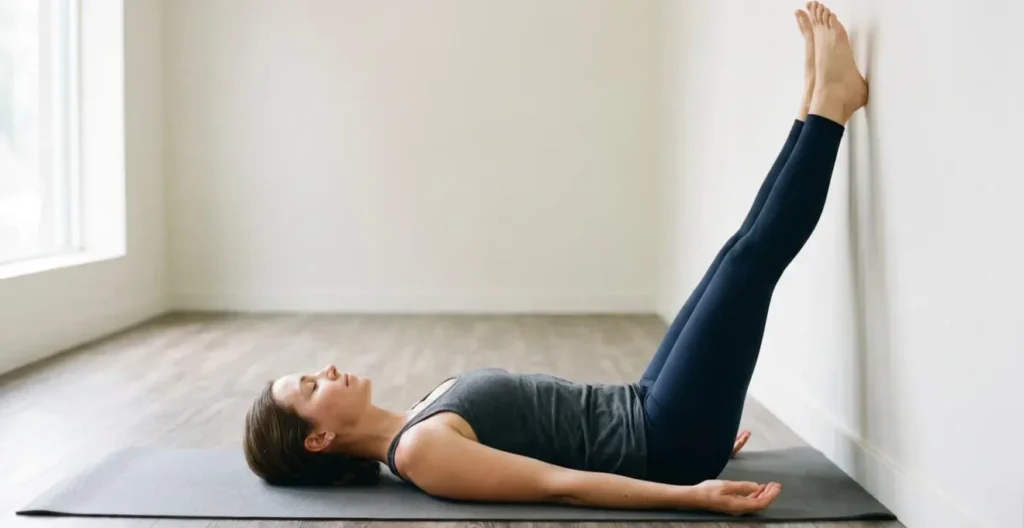
3-Minute Post-HIIT Parasympathetic Rebound Protocol
- Immediately after your final HIIT interval, walk slowly for 30-60 seconds to prevent blood pooling.
- Lie down on your back and elevate your legs against a wall (Viparita Karani position) to facilitate venous return.
- Engage in “physiological sigh” breathing: two sharp inhales through the nose, followed by one long, slow exhale through the mouth.
- Repeat the double-inhale, long-exhale pattern for 2-3 minutes while maintaining the legs-up position.
- Focus on extending the exhale to be twice as long as the inhale to maximally trigger the parasympathetic response.
- Remain in the position until your heart rate drops below 100 bpm and your breathing normalizes.
- This rapid downshift prevents the “tired but wired” feeling that can disrupt sleep hours later.
Which 4-7-8 Rhythm Puts You to Sleep Faster Than Melatonin?
While many people reach for a melatonin supplement to induce sleep, you possess a far more powerful and innate mechanism to trigger your body’s own sleep cascade: your breath. The 4-7-8 breathing technique, developed by Dr. Andrew Weil, is not just a relaxation exercise; it’s a neurological and chemical tool that directly signals to your brainstem that it is time to sleep. It works by manipulating the balance of oxygen and carbon dioxide in your bloodstream, a primary signal for shifting autonomic states.
When the parasympathetic nervous system is activated, a person will feel calm and relaxed. Studies have shown that insomnia has been linked with low parasympathetic activity and/or high sympathetic activity.
– Research summary from The Deep Sleep Co, How to Activate the Parasympathetic Nervous System for Better Sleep
The technique’s power lies in its specific rhythm. The 7-second breath-hold allows for a slight, controlled buildup of CO2, a state known as permissive hypercapnia. This increase in CO2 is a powerful signal to the vagus nerve and brainstem to slow the heart rate and calm the system. The extended 8-second exhale then maximally activates the parasympathetic response, more so than any other part of the breath cycle. This combination effectively acts as a natural tranquilizer for the nervous system, triggering the endogenous (internal) release of melatonin.
The physical sensations involved are also key. Resting your tongue on the roof of your mouth and focusing on the “whoosh” sound of the exhale provides an anchor for your attention, preventing your mind from wandering. This focus on interoception—the feeling of the breath inside your body—is what makes the practice so potent.
4-7-8 Breathing Technique with Interoceptive Enhancement
- Sit or lie in bed in a comfortable position with your tongue resting gently on the roof of your mouth, just behind your upper teeth.
- Exhale completely through your mouth, making a “whoosh” sound to empty your lungs.
- Close your mouth and inhale quietly through your nose for a count of 4.
- Hold your breath for a count of 7, allowing for permissive hypercapnia.
- Exhale completely through your mouth for a count of 8, making the “whoosh” sound.
- During the 8-count exhale, focus intently on the physical sensation of your chest and belly falling, anchoring your mind to your body.
- Repeat this cycle for a minimum of 4 times. Practicing this nightly trains your body’s natural sleep cascade.
Key Takeaways
- The “tired but wired” feeling is a physiological state of sympathetic dominance caused by low vagal tone.
- Directly stimulating the vagus nerve through humming or specific breathing patterns is more effective than generic relaxation.
- Active rest like NSDR restores brain chemistry (dopamine), while passive entertainment (Netflix) can deplete it.
Sauna vs. Hot Bath: Which Heat Therapy Boosts Slow Wave Sleep?
Leveraging your body’s core temperature is a powerful, non-negotiable tool for optimizing sleep architecture, particularly for increasing slow-wave (deep) sleep. Both saunas and hot baths work through the same fundamental mechanism: they initially raise your core body temperature, and the subsequent drop in temperature as you cool down is a potent biological signal for sleep initiation. Your body is evolutionarily programmed to associate a falling core temperature with the onset of night and rest.
So, which is better? While both are effective, the hot bath often holds a slight edge for pre-sleep routines due to its practicality and precise timing. A sauna session raises body temperature more intensely, but the cool-down period can be longer and less predictable. To trigger the sleep signal, you need this temperature drop to coincide with your desired bedtime. An overly long or intense sauna session can leave you feeling energized rather than relaxed if not timed perfectly.
A hot bath, on the other hand, is easier to control. Soaking for 15-20 minutes in water around 40°C (104°F), approximately 60-90 minutes before bed, is the ideal protocol. This duration is enough to significantly raise your core temperature. As you get out of the bath, your body works hard to radiate that heat, causing a steep and steady decline in core temperature that aligns perfectly with your entry into bed. This engineered temperature drop is one of the strongest cues you can give your body to begin producing melatonin and prepare for deep sleep.
Furthermore, you can enhance the parasympathetic effect of a bath by adding two cups of Epsom salts. The magnesium sulfate is absorbed through the skin, acting as a natural muscle relaxant and further calming the nervous system. While saunas offer excellent health benefits, for the specific goal of boosting slow-wave sleep, a well-timed hot bath is a more reliable and accessible tool for most people.
How to Increase Deep Sleep Percentage for Better Cellular Restoration?
Increasing your percentage of deep sleep isn’t about a single magic bullet; it’s about executing a strategic, multi-layered protocol in the 90 minutes before bed. This window is your opportunity to systematically dismantle the sympathetic state and build a powerful parasympathetic foundation for the night. Combining the principles of thermoregulation, neurochemistry, and nervous system signaling creates a cascade that guides your brain and body into sustained periods of slow-wave sleep, which is critical for cellular restoration and memory consolidation.
The protocol begins with nutrition and supplementation to provide your brain with the building blocks for calm. Glycine and taurine act as inhibitory neurotransmitters, quieting neuronal activity. This is followed by the core temperature drop engineered by a hot bath. The final phase is dedicated to direct nervous system regulation. Turning off screens and switching to dim, red-hued light minimizes the suppression of your natural melatonin production. This sets the stage for a short NSDR or yoga nidra session, which actively guides your brainwaves toward the theta state, the gateway to sleep.
The very last step, once in bed, is to use a tool like the 4-7-8 breathing technique to deliver the final, unambiguous signal to your brainstem to initiate the sleep cascade. This comprehensive approach ensures that you are not just hoping for sleep, but actively creating the ideal biological conditions for it to occur deeply and lastingly. Auditing your current routine is the first step to implementing this targeted approach.
Your 5-Step Evening Parasympathetic Audit
- Identify Stressors: List all sources of bright light, disruptive sound, and digital notifications you are exposed to in the 90 minutes before bed.
- Map Your Timeline: Note the precise timing of your last meal, any intense exercise, and when you last looked at a phone or computer screen.
- Assess Coherence: Does your current routine actively and intentionally lower stimulation, or does it accidentally maintain a state of alertness?
- Score Your State: Just before getting into bed, rate on a scale of 1-5 how “calm and grounded” (1) versus “wired and restless” (5) you feel.
- Plan Your Downshift: Based on this audit, identify one sympathetic trigger (e.g., scrolling social media) to replace with one parasympathetic practice from this guide (e.g., 5 minutes of humming).
The 90-Minute Pre-Sleep Protocol for Deep Sleep Optimization
- T-90 minutes: Have your final meal, including a glycine-rich food like bone broth or a gelatin-based dessert. Consider supplementing with Taurine (1-2g) and Glycine (3-5g).
- T-75 minutes: Prepare a hot bath with 2 cups of Epsom salts (magnesium) and 5-10 drops of lavender essential oil.
- T-60 minutes: Soak in the hot bath for 15-20 minutes to engineer the critical core temperature drop timed for bedtime.
- T-30 minutes: Turn off all overhead lights and electronic screens. Switch to dim, red-light lamps only to protect melatonin production.
- T-20 minutes: Begin a 10-minute NSDR or yoga nidra session to guide your brain toward restorative theta waves.
- T-10 minutes: Get into bed in a cool room (16-19°C or 60-67°F) and begin the 4-7-8 breathing protocol for at least 4 cycles.
- T-0: Lights out. Focus on the sensation of your body sinking into the mattress as you drift into sleep.
To put these principles into practice, start by implementing one or two of these techniques tonight. Notice the shift in your physical and mental state, and gradually build your own personalized pre-sleep protocol for deep, restorative rest.