
The secret to silencing “creaky” joints isn’t just supplements or passive stretching, but actively teaching your body to lubricate itself through conscious, controlled movement.
- Specific rotational movements (CARs) act as a “synovial pump,” stimulating fresh lubricating fluid in the joint capsule.
- Hydration is only effective when paired with movement, which is required to deliver water into the cartilage “sponge.”
- Building functional strength around the joints makes daily activities effortless and protects your newfound mobility.
Recommendation: Focus on a daily habit of gentle, full-range joint rotations to start reclaiming smooth, pain-free movement from the inside out.
That first step out of bed in the morning can be a noisy affair. A symphony of clicks, pops, and crunches from your knees or hips that feels less like a body waking up and more like a rusty gate swinging open. This morning stiffness, that “creaky” feeling, is a common companion for many over 50. It’s a physical reminder that our joints aren’t as forgiving as they once were, often sending us in search of a quick fix.
The typical advice is well-meaning but often incomplete. We’re told to drink more water, take some turmeric, or stretch a little. While these things have their place, they are largely passive approaches. They treat the joint like a machine part that needs external oiling. This approach overlooks the most powerful tool at your disposal: the body’s own incredible ability to heal and maintain itself.
But what if the true key to restoring joint lubrication isn’t found in a pill or a simple stretch, but in relearning how to move with intention? What if you could actively signal your joints to produce their own fresh, nourishing synovial fluid? The answer lies not in more movement, but in better, more intelligent movement. This guide is about transforming your joints from passive, creaky structures into active, self-oiling systems.
We will explore the very mechanics of why your joints feel stiff, then dive into the precise, gentle movements that can restore their natural lubrication. From the foundational role of Controlled Articular Rotations (CARs) to the supportive power of nutrition and the game-changing impact of functional strength, you will discover a restorative path to smoother, more comfortable movement, no injections required.
Summary: A Restorative Guide to Joint Lubrication
- Why Does Morning Stiffness Disappear After 10 Minutes of Movement?
- How to Perform CARs to Lubricate Your Hips Every Morning?
- Omega-3s vs. Turmeric: Which Is Better for Joint Lubrication?
- The Hydration Link: Is Your Knee Pain Actually Thirst?
- Which Micro-Movements Can You Do at Your Desk to Keep Joints Oiled?
- Which 3 Loaded Stretches Will Unlock Your Hips in 30 Days?
- How to Perform the “Chin Tuck” Correctly to Decompress Your Nerves?
- How to Use Functional Resistance Training to Make Daily Chores Effortless?
Why Does Morning Stiffness Disappear After 10 Minutes of Movement?
That familiar feeling of being “locked up” in the morning has a simple physiological explanation: the gelling of synovial fluid. Synovial fluid is your body’s natural joint lubricant, a viscous substance that fills the joint capsule, nourishing the cartilage and allowing bones to glide smoothly past each other. When you are inactive for a long period, like during sleep, this fluid thickens and becomes more gel-like. Your joints are literally “stuck” in a more viscous environment.
When you start to move, you initiate a powerful, natural process. The movement acts as a synovial pump, warming and circulating the fluid, causing it to become thinner and more liquid. This change in viscosity allows for smoother articulation and is why that initial stiffness and creakiness often subsides after a few minutes of walking around or gentle activity. It’s the body’s built-in “warm-up” cycle.
It is important, however, to distinguish this common morning stiffness from a more persistent issue. As a medical reference on joint stiffness notes, “Morning stiffness pain which eases up after the joint has been used, is characteristic of rheumatoid arthritis.” While the mechanism is similar, if your stiffness is severe, prolonged (lasting more than 30-60 minutes), or accompanied by significant pain and swelling, it’s essential to consult a healthcare professional. For most, however, that initial 10 minutes of gentle motion is simply the time it takes to get your body’s own lubricant flowing again.
Understanding this process is the first step toward taking control. The goal, then, is not just to endure this morning ritual, but to optimize it with specific movements that lubricate the joints more effectively.
How to Perform CARs to Lubricate Your Hips Every Morning?
If morning stiffness is caused by gel-like synovial fluid, then Controlled Articular Rotations, or CARs, are the most direct and effective way to address the root cause. They are not stretches; they are active, rotational movements designed to take a joint through its greatest possible pain-free range of motion. This deliberate action serves as the most powerful signal to the joint capsule to produce and circulate fresh, healthy synovial fluid.
The philosophy behind this practice was pioneered by experts in functional mobility. As Dr. Andreo Spina, founder of Functional Range Systems, explains, CARs involve slow and deliberate rotational movements at the joints with the goal of moving each joint through its full, pain-free range. This teaches the nervous system to control the joint at its outer limits, which is key for both mobility and injury prevention.
For the hips, which are common sites of stiffness, a daily CARs routine is like a targeted dose of lubrication. The movement should be slow, deliberate, and controlled, as if you are drawing a smooth circle in the air with your knee.
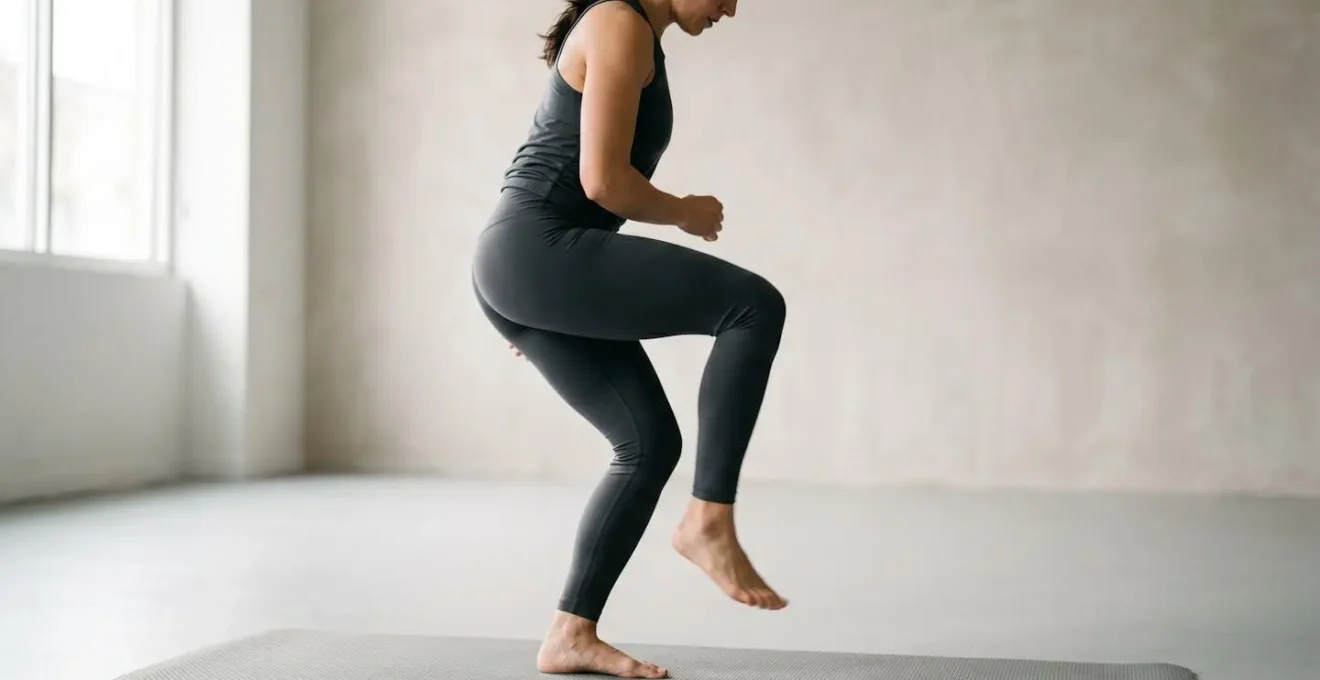
To perform a standing Hip CAR, follow these steps to ensure you are moving the hip joint itself, not just compensating with your back or pelvis:
- Step 1: Start in a comfortable standing position, feet shoulder-width apart. Engage your core to keep your spine neutral and your pelvis stable. You can hold onto a wall for balance.
- Step 2: Begin by raising one knee toward your chest as high as you comfortably can, keeping the knee bent.
- Step 3: From this high-knee position, open the knee out to the side, as if moving it over a small hurdle. This is hip abduction.
- Step 4: Now, begin to rotate the hip internally, bringing your foot up behind you as you trace the circle back and down to the starting position.
- Step 5: Perform 5-10 slow, controlled repetitions in one direction, focusing on making the circle as large and smooth as possible without pain. Then, reverse the direction for another 5-10 reps.
- Step 6: Repeat the entire process with the other leg. Make this a non-negotiable part of your morning routine.
By performing this simple routine each morning, you are not just warming up; you are actively maintaining the health and longevity of your hip joints from the inside out.
Omega-3s vs. Turmeric: Which Is Better for Joint Lubrication?
While movement is the primary driver of joint lubrication, nutrition plays a crucial supportive role by managing the underlying environment of the joint. When it comes to joint health, two supplements consistently rise to the top: Omega-3 fatty acids and turmeric (specifically, its active compound, curcumin). Both are famed for their anti-inflammatory properties, but they work through different mechanisms, and one may have a slight edge for lubrication-related benefits.
Omega-3 fatty acids, typically found in fatty fish like salmon, mackerel, and sardines, are integral components of cell membranes throughout the body. They are precursors to powerful anti-inflammatory molecules called resolvins and protectins. By helping to resolve inflammation, Omega-3s can reduce the pain and swelling that may hinder joint movement and synovial fluid quality. Their effectiveness is well-documented; in fact, Omega-3 PUFA supplementation significantly relieves arthritis pain, as shown in a large 2023 meta-analysis. This pain reduction makes it easier to perform the movements necessary for lubrication.
Turmeric’s power comes from curcumin, a potent antioxidant that can neutralize free radicals and block inflammatory pathways, particularly the NF-kB pathway. It’s a powerful compound for managing acute and chronic inflammation, which is why it’s so popular for joint pain relief. However, its direct impact on synovial fluid quality is less studied than that of Omega-3s.

So, which is better? For the specific goal of improving the environment for joint lubrication, Omega-3s likely have a slight advantage. They are not just anti-inflammatory; they are pro-resolving, meaning they help the body actively shut down the inflammatory process and return to baseline. This creates a healthier, less-inflamed environment in which the synovial fluid can better do its job. Turmeric is an excellent partner, tackling inflammation from a different angle.
Ultimately, think of these supplements as a way to create a more favorable “terrain” within the joint. They quiet the inflammatory noise, allowing the real work of lubrication—driven by your daily movements—to happen more effectively.
The Hydration Link: Is Your Knee Pain Actually Thirst?
The advice to “drink more water for your joints” is one of the most common health platitudes, and for a good reason—it’s fundamentally true. But it’s also profoundly incomplete. Simply increasing your water intake without understanding the delivery mechanism is like watering the leaves of a plant and hoping the roots get nourished. To truly hydrate your joints, you need both water and movement.
The key lies in the composition of your articular cartilage, the smooth, white tissue that caps the ends of your bones. As medical research confirms, 70-80% of joint cartilage consists of water. This high water content is what gives it shock-absorbing, compressive properties. Think of your cartilage as a dense sponge. When the joint is compressed (for example, when you take a step), the sponge is squeezed, and waste products are pushed out. When the compression is released, the sponge expands and sucks in fresh, nutrient-rich synovial fluid—which is itself mostly water.
This is the crucial link: hydration without movement is ineffective. If you are dehydrated, your synovial fluid becomes thicker and less abundant, and the cartilage “sponge” has nothing to absorb. Conversely, if you are well-hydrated but sedentary, the fluid doesn’t get pumped in and out of the cartilage effectively. Waste products can build up, and nutrients aren’t delivered. This is why long periods of sitting can make joints feel stiff and achy, even if you’ve been drinking water all day.
Therefore, your knee pain might indeed be a signal of thirst, but it’s a thirst of the cartilage itself, which can only be quenched by the pumping action of movement. Every step you take, every squat you perform, every gentle joint rotation is an act of actively pushing nourishing fluid into the very tissues that need it most. This makes consistent, gentle movement throughout the day even more important than just hitting a daily water quota.
The most effective hydration strategy for your joints is to sip water consistently throughout the day and pair it with frequent “movement snacks” to ensure that water gets delivered where it’s needed most.
Which Micro-Movements Can You Do at Your Desk to Keep Joints Oiled?
For many of us, the biggest enemy of joint health is the chair. Long hours of sitting lead to stagnation, causing synovial fluid to thicken and joints to feel stiff. The antidote isn’t a single, intense workout at the end of the day, but rather a consistent stream of gentle “movement snacks” woven throughout your workday. These micro-movements are designed to keep the synovial pump active, ensuring your joints stay lubricated and comfortable.
The goal is frequency over intensity. It is far more effective to do one minute of movement every 30 minutes than 10 minutes every four hours. This constant circulation prevents the fluid from “gelling” and keeps the cartilage nourished. A simple timer or the Pomodoro technique (working in 25-minute blocks with short breaks) can be a great way to build this habit.
Here is a simple but powerful routine, the “Micro-Trifecta,” that you can perform right at your desk without drawing much attention:
- Gentle Articular Rotations (Every 30 minutes): These are the most direct way to stimulate synovial fluid. While seated, slowly perform ankle circles (10 in each direction for each foot) and wrist circles (10 in each direction for each hand). Focus on making the movements smooth and continuous.
- Isometric Activations (Every 45 minutes): This creates a gentle pumping action in the larger joints. While seated, straighten one leg and squeeze your quadriceps muscle for 5 seconds, then release. Follow by squeezing your glutes together for 5 seconds. Repeat this cycle 3-5 times. This engages the muscles around the knee and hip joints without any visible movement.
- Dynamic Stretches (Every hour): These move the joints through a larger, yet still gentle, range of motion. Perform seated knee-to-chest hugs (gently pull one knee towards your chest, hold for 2-3 seconds, repeat 5 times per leg), shoulder rolls (10 forward, 10 backward), and slow, gentle neck rotations (5 in each direction, avoiding any pinching or pain).
By sprinkling these micro-movements throughout your day, you transform your workspace from a place of stagnation into a dynamic environment that promotes joint health and prevents the onset of stiffness and pain.
Which 3 Loaded Stretches Will Unlock Your Hips in 30 Days?
Once you have established a daily routine of gentle lubrication with CARs, you may find you want to expand your pain-free range of motion. This is where loaded stretching comes in. Unlike passive stretching where you just relax into a position, loaded stretching involves actively contracting muscles at your end-range of motion. This powerful technique, often involving principles of Proprioceptive Neuromuscular Facilitation (PNF), teaches your nervous system that this new range is safe and strong, effectively “unlocking” it for daily use.
This is not a beginner’s first step, but a logical progression for those who want to move from simply maintaining their joints to actively improving their mobility. The process requires patience and consistency, but it yields profound and lasting results. It’s about earning your mobility, not just forcing it.
The following plan is a 30-day progression to safely and effectively increase hip mobility. It’s crucial to listen to your body and never push into sharp pain. Discomfort at the end range is normal; sharp pain is a stop signal.
Your 30-Day Hip-Unlocking Action Plan
- Principle 1 – Master the Passive Range (Days 1-7): The first week is about exploration. Spend time in foundational passive stretches like the 90/90 position, pigeon pose, and a deep squat hold. Hold each stretch for 2-3 minutes, breathing deeply and allowing your body to relax into the position. This familiarizes your tissues with the end-range position.
- Principle 2 – Introduce Isometric Contraction (Days 8-21): Now, the magic happens. In your passive stretch (e.g., the 90/90), at your deepest point, begin to add isometric contractions. Gently press the front shin/knee into the floor for 5-10 seconds (this is a PAILs contraction). Then, relax and try to actively pull your torso deeper into the stretch for 5 seconds (a RAILs contraction). This tells your brain to create strength at this new depth.
- Loaded Stretch 1 – 90/90 with Isometric PAILs: Sit in the 90/90 hip position. Lean forward over the front shin to your end range. Press the front shin firmly into the ground for 10 seconds (contract), then actively pull your chest further forward for 5 seconds (relax and deepen). Perform 3 sets per side.
- Loaded Stretch 2 – Kneeling Hip Flexor Stretch with Active Lift: In a kneeling lunge, sink into the stretch. Then, actively contract your hip flexor as if trying to lift your back knee slightly off the ground. Hold this activation for 5-10 seconds. Perform 3 sets per side.
- Loaded Stretch 3 – Frog Stretch with Adductor Activation: In a wide-knee frog position, sink your hips back. Press both knees outward into the ground isometrically for 10 seconds, then use your adductors to try and pull yourself deeper for 5 seconds. Perform 3 sets.
By systematically applying these principles, you are not just stretching your hips; you are fundamentally reprogramming your body’s capacity for movement, building a foundation of strong, resilient, and mobile joints.
How to Perform the “Chin Tuck” Correctly to Decompress Your Nerves?
In our modern world of screens, “forward head posture” is an epidemic, and it’s a major contributor to neck stiffness, headaches, and even nerve-related symptoms like tingling in the arms. The “chin tuck” is a classic physical therapy exercise prescribed to counteract this, but it’s often performed incorrectly, leading to frustration and minimal results. A proper chin tuck isn’t about aggressively jamming your chin back; it’s a subtle, gentle movement focused on axial elongation—lengthening the back of your neck.
The goal is to relieve compression on the cervical spine and the nerves that exit from it. When performed correctly, it creates space between the vertebrae and activates the deep neck flexor muscles, which are crucial for maintaining good posture. The key is to reframe the mental cue from “tucking the chin” to “making a long neck.” Imagine a string gently pulling the crown of your head up towards the ceiling.
Integrating this movement into your daily life is where its true power lies. It’s not just an exercise to be done for 5 minutes a day, but a posture to be adopted during everyday activities. This functional integration helps decompress the nerves throughout the day.

Here is a step-by-step protocol for mastering and integrating the chin tuck:
- Step 1 – Link to Exhale: Sit or stand tall with relaxed shoulders. As you exhale, initiate the chin tuck, visualizing the back of your neck lengthening. The exhale naturally engages your core stabilizers, which support the posture.
- Step 2 – Visualize Axial Elongation: Instead of forcing your chin, focus on making a “double chin” while simultaneously lifting the base of your skull upward. You should feel a gentle stretch at the back of your neck.
- Step 3 – Static Hold Practice: Hold this lengthened position for 5-10 seconds while breathing normally. Don’t hold your breath. Perform 5 repetitions, several times a day.
- Step 4 – Functional Integration: Maintain this “long neck” posture when you bend to pick something up. Hinge at your hips, keeping your head and neck in line with your spine.
- Step 5 – Phone Use Application: This is critical. Instead of dropping your head to look at your phone, lift the device to your eye level, maintaining the elongated neck position.
By making the “long neck” your default posture, you actively decompress your cervical spine, reduce nerve irritation, and build the endurance needed to combat the postural challenges of modern life.
Key Takeaways
- The foundation of joint health is active, controlled movement (like CARs), which acts as a “synovial pump” to lubricate your joints from within.
- Hydration and anti-inflammatory nutrition (Omega-3s, turmeric) are crucial support systems, but they are ineffective without the circulatory action of movement.
- True mobility is built by combining gentle daily lubrication with targeted strength training, making your joints not just flexible, but resilient and protected.
How to Use Functional Resistance Training to Make Daily Chores Effortless?
Restoring synovial fluid and unlocking mobility are the first crucial steps. But to make this newfound freedom last, you must protect it. This is the role of functional resistance training. Its purpose is not to build bulky muscles, but to strengthen the fundamental movement patterns you use every single day. By making these patterns stronger, you reduce the strain on your joints during daily tasks, making chores feel effortless and safeguarding your mobility for the long term.
Functional training recognizes that we don’t move in isolation. We squat to get up from a chair, we hinge to pick up groceries, and we push, pull, and carry things all day long. By training these five core patterns, you build a body that is resilient and capable, where the muscles do the work, and the joints are free to move smoothly.
The beauty of this approach is its direct translation to real life. A stronger hinge pattern doesn’t just mean a better deadlift; it means picking up a laundry basket without a twinge in your back. A stronger squat pattern means getting up from the floor with ease. The following table maps these fundamental movements to daily life, showing how a simple exercise directly improves a common chore.
| Movement Pattern | Daily Chore Example | Key Resistance Exercise | Joint Benefits |
|---|---|---|---|
| Hinge | Picking up laundry basket, lifting groceries from car trunk | Kettlebell Deadlift or Banded Good Morning | Protects lower back, lubricates hip joints through full flexion-extension |
| Squat | Getting up from chair, picking up items from low shelves | Goblet Squat or Bodyweight Squat | Strengthens knee joint stabilizers, improves hip and ankle mobility |
| Push | Opening heavy doors, pushing vacuum cleaner, moving furniture | Push-ups or Dumbbell Chest Press | Builds shoulder stability, protects shoulder joint during overhead and forward movements |
| Pull | Opening drawers, carrying shopping bags, pulling weeds in garden | Resistance Band Rows or Inverted Rows | Balances shoulder joint forces, improves scapular control and elbow joint integrity |
| Carry | Carrying groceries, holding child, transporting laundry | Farmer’s Carry or Suitcase Carry | Trains core canister pressure, protects spine, improves grip strength and wrist joint endurance |
Start by incorporating one exercise from each category into your routine once or twice a week. Focus on good form over heavy weight. This final piece of the puzzle transforms your body from one you are constantly trying to fix, to one that is strong, capable, and ready for all the demands of life.