The “BPA-Free” label on your child’s plastic containers is misleading; many substitutes are just as hormonally disruptive as the original.
- Heating food in any plastic, even “microwave-safe” types, can release billions of hormone-mimicking nanoplastic particles into your meal.
- Most common pitcher water filters are ineffective at removing endocrine disruptors; only specific certifications like NSF/ANSI 401 offer proven protection.
Recommendation: The only way to ensure safety is to systematically replace plastic with inert materials like glass and stainless steel, focusing first on items that touch hot or fatty foods.
As a parent, you meticulously plan every meal, ensuring your child gets the best nutrition. But what if the very containers you use to store and heat that healthy food are silently undermining their development? Every time you pack a lunch in a plastic box or microwave leftovers, you could be exposing your family to a class of chemicals known as endocrine disruptors. These compounds, particularly xenoestrogens, are chemical imposters that mimic the hormone estrogen, creating a potential for serious developmental and health issues down the line.
The common advice is to simply “avoid plastic” and look for “BPA-free” labels. This is dangerously simplistic. The reality is that we are dealing with a complex and pervasive toxic ecosystem, not just a few bad containers. The chemicals that replaced BPA are now showing similar, if not worse, hormonal activity. The threat isn’t just in your Tupperware; it’s in your tap water, your non-stick pans, and even the soap you use to wash your hands before preparing food.
But if the true key isn’t just swapping one plastic for another, what is the answer? It’s about dismantling this toxic exposure system at its source. This guide provides a practical, science-backed strategy to do just that. We will move beyond the superficial advice to reveal the hard science behind chemical leaching, identify the true safe alternatives, and give you a prioritized, budget-friendly plan to create a genuinely non-toxic kitchen environment for your family.
This article provides a complete roadmap for detoxifying your kitchen. We will explore the science of estrogen mimicry, detail a step-by-step replacement plan, and expand our view to the entire home ecosystem to ensure your family’s long-term health and well-being.
Summary: Your Complete Kitchen Detoxification Plan
- Why Your Plastic Tupperware Is Mimicking Estrogen in Your Body?
- How to Replace Your Plastic Kitchenware Without Breaking the Bank?
- BPA-Free vs. Glass: Is the “Safer” Plastic Actually Safe?
- The Microwave Mistake: What Happens When You Heat Food in Plastic?
- Which Pitcher Filter Actually Removes Hormones From Tap Water?
- The Beauty Routine Mistake That Adds Estrogen to Your Body
- Why “Juice Cleanses” Fail If You Don’t Support Phase 2 Liver Detox?
- How to Create a Non-Toxic Ecosystem in Your Home for Better Air Quality?
Why Your Plastic Tupperware Is Mimicking Estrogen in Your Body?
The core of the problem lies in a specific class of chemicals used to make plastics hard and durable, most famously Bisphenol A (BPA). These chemicals are classified as xenoestrogens, meaning they are foreign substances that the body mistakes for the hormone estrogen. Imagine your body’s cells have specific locks, called estrogen receptors. The natural estrogen hormone is the perfect key for these locks, triggering critical biological processes related to development, reproduction, and metabolism. Xenoestrogens are like poorly made copies of that key. They can fit into the lock, either weakly activating it or, more dangerously, blocking the real key from ever getting in. This disruption of the delicate endocrine system is especially concerning for children, whose bodies are in a constant state of hormonally-guided development.
When you store food in plastic containers, especially acidic or fatty foods, these xenoestrogen molecules can “leach” or migrate from the plastic into your meal. The process is significantly accelerated by heat from a microwave or even a hot dishwasher cycle. You are, in effect, serving a dose of these hormonal imposters along with your healthy food. While a single exposure is minuscule, the danger lies in bio-accumulation—the steady, daily build-up of these compounds in the body’s fatty tissues. Over years, this low-grade, chronic exposure can contribute to a wide range of health issues. Emerging research even demonstrates that many so-called “safer” BPA substitutes like BPS and BPF may not be safer at all in relation to endocrine disrupting activity.
How to Replace Your Plastic Kitchenware Without Breaking the Bank?
The thought of replacing an entire kitchen’s worth of containers and tools can be overwhelming and expensive. The key is a phased, strategic approach, not a one-day overhaul. You don’t need to throw everything out at once. Instead, prioritize replacing the items that pose the greatest risk first. Start with any plastic that comes into contact with heat—your most-used food storage containers for leftovers, your microwave covers, and plastic cooking utensils like spatulas or serving spoons. Common replacements like bamboo cutting boards are a great choice as they are naturally antimicrobial and don’t harbor plastics. From there, you can progressively swap out other items as your budget allows. Many families find that they can begin for free by simply reusing glass jars from pasta sauce, pickles, and jams for storing dry goods, dressings, and refrigerated items.
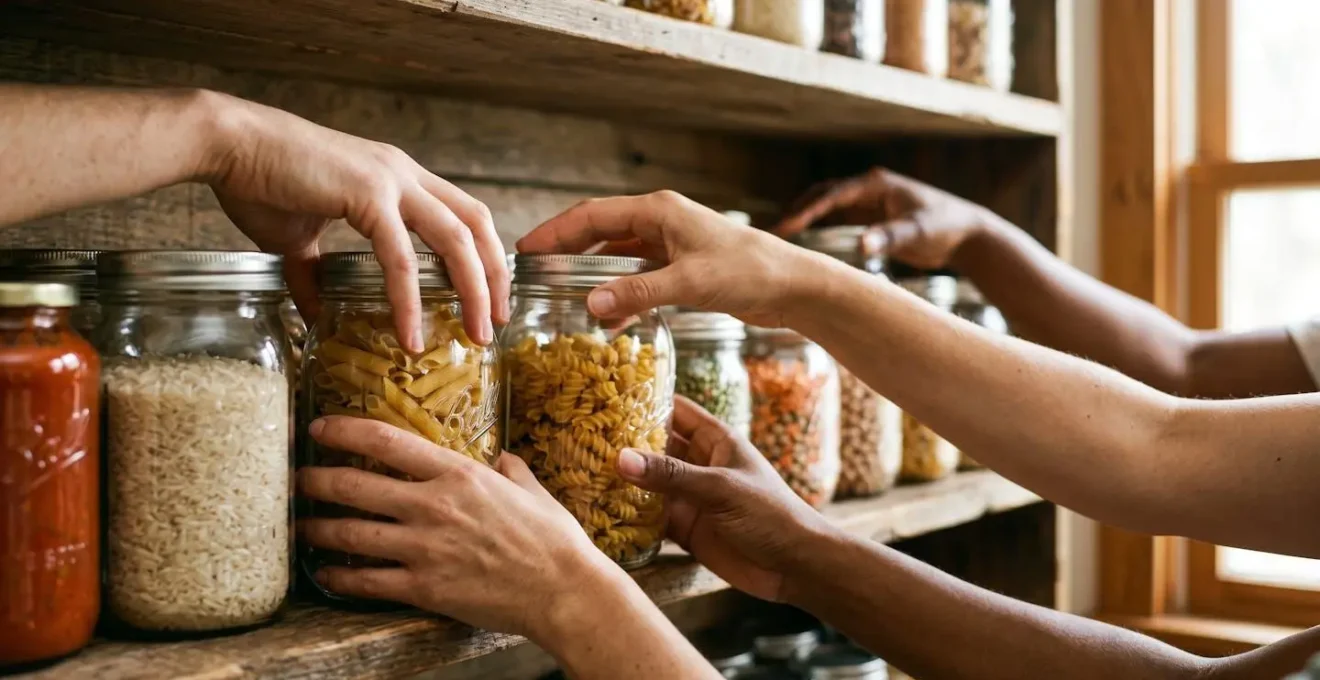
This image perfectly illustrates the first, cost-effective step. Reusing existing glass jars for pantry staples like rice, pasta, and beans is an immediate way to reduce plastic contact with your food. The ultimate goal is to transition to inert materials like borosilicate glass and stainless steel for all food contact, especially for hot and fatty foods, as these materials do not leach chemicals.
Your 5-Point Kitchen Detox Audit
- Identify High-Heat Contact Points: Make a list of all plastic items that touch hot food or go in the microwave or dishwasher (e.g., containers, utensils, spatulas, baby bottles). These are your highest priority for replacement.
- Inventory High-Fat Storage: Catalogue all plastic containers and bottles used for storing oily or fatty foods (e.g., salad dressings, leftovers with oil, cheese, nut butters), as fats accelerate chemical leaching.
- Assess “Safe” Plastics: Check the recycling codes on all “BPA-Free” items. Identify and flag any with codes #3 (PVC), #6 (PS), or #7 (Other/Polycarbonate) as high-risk for containing concerning substitutes.
- Evaluate Water and Beverage Sources: List all plastic pitchers, reusable water bottles, and filter systems. Research their materials and check for an NSF/ANSI 401 certification to verify they remove endocrine disruptors.
- Create a Phase-Out Plan: Using your lists, prioritize replacing items from Step 1, then Step 2. Immediately tag old plastic containers as “non-food use only” for organizing crafts or garage items to prevent accidental use.
BPA-Free vs. Glass: Is the “Safer” Plastic Actually Safe?
In response to public concern, manufacturers rushed to market “BPA-free” products. This label, however, has created a false sense of security and is a prime example of a phenomenon known as “regrettable substitution.” Instead of reformulating products to be inherently safer, companies often simply swapped BPA for chemically similar compounds, such as Bisphenol S (BPS) or Bisphenol F (BPF). Because these substitutes are not BPA, the product can be legally labeled “BPA-free,” leading consumers to believe it’s a healthier choice. This is a dangerous marketing tactic. The question of whether it’s safe to use these “safer” plastics for food storage is being answered with a resounding “no” by the scientific community.
The problem is that these substitute chemicals are structurally very similar to BPA and, as a result, have similar estrogen-mimicking effects on the body. Some studies even suggest they could be worse. For example, laboratory testing revealed that BPF showed an average estrogenic potency equal to or even greater than the BPA it replaced. This means you might be avoiding one known hazardous chemical only to expose your family to another, equally potent one. As one research team noted in a major study on bisphenol replacements:
Marketing a product as ‘BPA free’ suggests to the consumer that a product is safer, but research shows that replacement bisphenols have adverse effects similar to, or even greater than, BPA.
– Research team, Plakogiannis Laboratory, PNAS study on bisphenol replacement chemicals in human tissue
The only way to be certain you are not exposing your family to these hormone-disrupting chemicals is to opt out of the plastic game entirely. Materials like glass and 18/8 or 304 grade stainless steel are inert. They don’t have a chemical structure that can break down and leach into your food, regardless of whether the food is hot, cold, fatty, or acidic. They are the only truly safe choice.
The Microwave Mistake: What Happens When You Heat Food in Plastic?
Heating plastic is the single most effective way to accelerate the transfer of harmful chemicals into your food. Even if a container is labeled “microwave-safe,” this label is misleading. It only means the plastic won’t warp or melt at microwave temperatures; it says absolutely nothing about the invisible cascade of chemicals and plastic particles being released. The combination of heat and electromagnetic radiation acts like a pressure washer, blasting micro- and nanoparticles from the container’s surface directly into your meal. The scale of this contamination is staggering.
Case Study: The Alarming Reality of Microwaved Plastic
A comprehensive review analyzing multiple peer-reviewed studies found that microwaving plastic containers released a cocktail of chemicals into food. This included at least 42 “intentionally added substances” (like plasticizers and stabilizers) and over 100 “non-intentionally added substances” (impurities and breakdown products). The research confirmed that higher power levels and longer heating times dramatically increased the release of these compounds. Most alarmingly, containers that were old or showed visible scratches released nearly twice as many microplastics as new ones, proving that the risk increases over the lifespan of the product.
The numbers are even more concerning when looking at particle counts. A groundbreaking 2023 University of Nebraska study found that some containers released up to 4.22 million microplastic and 2.11 billion nanoplastic particles per square centimeter of container surface within just three minutes of microwave heating. Nanoparticles are particularly insidious because they are small enough to potentially pass through the intestinal wall and travel throughout the body. The same principle applies to washing plastics in a dishwasher; the high heat and harsh detergents degrade the material over time, increasing its propensity to leach chemicals and shed particles in subsequent uses.
Which Pitcher Filter Actually Removes Hormones From Tap Water?
Your kitchen’s toxic ecosystem isn’t limited to food containers. Tap water can be a significant source of endocrine disruptors, including residues from birth control pills (estrone), pharmaceuticals, and industrial chemicals like BPA that find their way into the water supply. Many parents trust a simple pitcher filter to solve this, but most are woefully inadequate for this specific task. The majority of basic pitcher filters use simple activated carbon, which is primarily designed to improve taste and odor (like chlorine) and may only be certified to NSF/ANSI Standard 42. They lack the technology to capture complex chemical compounds like hormones.
To effectively remove these contaminants, you need a filter certified to a higher standard: NSF/ANSI 401. This certification specifically tests a filter’s ability to remove “emerging contaminants,” a category that includes hormones and pharmaceuticals. As independent NSF testing confirms, filters certified to Standard 401 are proven to reduce 15 specific compounds, including estrone and BPA. The following table, based on data from a recent comparative analysis, breaks down the effectiveness of different technologies.
| Filter Technology | NSF Certification Typical | Removes Hormones/Pharma | Removes Pesticides | Effectiveness for EDCs | Cost Range |
|---|---|---|---|---|---|
| Basic Activated Carbon (pitcher) | NSF 42 only | No | Limited | Poor – taste/odor only | $20-60 |
| Advanced Carbon Block | NSF 42, 53, 401 | Yes (if NSF 401) | Yes (selective) | Good for certified compounds | $150-400 |
| Ion Exchange | NSF 42, 53 | No | No | Poor – targets minerals only | $100-300 |
| Reverse Osmosis + Carbon | NSF 42, 53, 58, 401 | Yes | Yes | Excellent – 90-99% reduction | $200-900 |
| RO Membrane alone | NSF 58 | Yes (85-95%) | Yes (90%+) | Very Good | $150-500 |
As the table shows, Reverse Osmosis (RO) systems combined with a carbon block filter offer the most comprehensive protection. However, some high-quality carbon block filters (often in countertop or under-sink models) can also achieve NSF 401 certification. As the TapWaterData Water Quality Research Team notes, pitcher filters rarely achieve this due to the short time the water is in contact with the filter media. When shopping, ignore marketing claims and look for the official NSF/ANSI 401 certification mark on the packaging.
The Beauty Routine Mistake That Adds Estrogen to Your Body
The kitchen sink is a major intersection for chemical exposure that most people overlook. Endocrine disruptors are not just in plastics; they are prevalent in personal care products in the form of parabens (preservatives) and phthalates (fragrance carriers). When you use conventional hand soaps, shampoos, lotions, or deodorants, these chemicals are absorbed through your skin. But a more direct route of ingestion happens right at the kitchen counter. A residue of these chemicals remains on your hands after washing. When you then handle food—chopping vegetables, making a sandwich, or portioning out a snack for your child—you are directly transferring these hormonal toxins from your hands to the food, which is then ingested.
This creates a compounding effect, adding a significant exposure pathway on top of what may already be leaching from packaging or cookware. A recent 2024 study in the Journal of Exposure Science found that 3,601 chemicals were detected in both food packaging materials and human bodies, highlighting the pervasive nature of this contamination from multiple sources.
Case Study: The Hand-to-Mouth Contamination Route
A European study (Hypiend project) tracked families to understand exposure pathways. When participants switched their daily cosmetic and hygiene products—including hand soaps, shampoos, and deodorants—to certified non-toxic alternatives and practiced frequent handwashing, their biomarker levels for specific endocrine disruptors dropped significantly. The research specifically emphasized that parabens and phthalates from hand soaps and other cosmetics are transferred directly to food during meal preparation. This creates a direct ingestion route that is often more potent than dermal absorption alone, as it bypasses the skin’s protective barrier and goes straight into the digestive system.
The solution is twofold. First, audit your personal care products, starting with the hand soap at your kitchen sink. Replace them with products that are explicitly free of parabens, phthalates, and synthetic fragrances. Second, be mindful of the “hand-to-food” pathway, ensuring hands are washed thoroughly with a non-toxic soap before any food preparation.
Why “Juice Cleanses” Fail If You Don’t Support Phase 2 Liver Detox?
While reducing exposure is the most critical step, you can also actively support your body’s natural ability to remove the endocrine disruptors it has already absorbed. This process is managed primarily by the liver, through a two-step system known as Phase 1 and Phase 2 detoxification. Many fad “detoxes” and “juice cleanses” fail because they may support Phase 1 but neglect Phase 2. Phase 1 takes a toxin and converts it into an intermediate form, which is often *more* reactive and potentially more dangerous than the original toxin. Phase 2 then takes this intermediate and attaches another molecule to it (a process called conjugation), making it water-soluble and safe for excretion through urine or bile.
If Phase 2 isn’t working efficiently, these highly reactive intermediate toxins can build up in the body, causing cellular damage. Supporting Phase 2 is not about extreme diets; it’s about providing the specific nutritional building blocks the liver needs to do its job. This is where your cooking and food choices become a powerful tool. You can enhance your family’s resilience to toxic exposure by incorporating specific foods that are rich in the compounds needed for effective Phase 2 conjugation.
- Cruciferous Vegetables: Items like broccoli, cauliflower, and kale provide sulforaphane, a potent activator of Phase 2 enzymes. Lightly steaming them for 3-4 minutes is the best way to preserve this compound.
- Sulfur-Rich Alliums: Garlic, onions, and leeks supply sulfur compounds essential for producing glutathione, the body’s master antioxidant and a key player in Phase 2. Let chopped garlic sit for 10 minutes before cooking to maximize its benefits.
- High-Quality Protein: Organic eggs, grass-fed meats, and wild-caught fish provide critical amino acids like glycine and cysteine, which are the direct building blocks used in conjugation pathways.
- Citrus and Berries: These fruits provide flavonoids and Vitamin C, which support both detox phases and act as antioxidants to protect cells from the intermediate toxins.
- Green Tea: The catechins in green tea have been shown to enhance the activity of several key Phase 2 enzymes.
By focusing on a diet rich in these whole foods, you empower the body’s own sophisticated detoxification system, providing a real, science-based defense that no juice cleanse can match.
Key takeaways
- The “BPA-Free” label is unreliable; switch to inert materials like glass and stainless steel for all food contact, especially when heated.
- Not all water filters are equal. To remove hormones and other endocrine disruptors, verify your filter has an NSF/ANSI 401 certification.
- Support your body’s natural resilience by incorporating Phase 2 liver-support foods like broccoli, garlic, and high-quality protein into your family’s diet.
How to Create a Non-Toxic Ecosystem in Your Home for Better Air Quality?
Expanding from the kitchen, the final step is to view your entire home as a single, interconnected ecosystem. Endocrine-disrupting chemicals don’t stay put. They are released from a multitude of consumer products and travel through the air, settling in household dust which you and your children then inhale or ingest. This dust acts as a repository for chemicals from every room. PFAS “forever chemicals” from pizza boxes and microwave popcorn bags, phthalates from vinyl flooring, and flame retardants from furniture and electronics all end up in the dust on your floors.
Even though they’re linked to hormone disruption and cancer, PFAS and flame retardant chemicals are used in many common household products. Research shows that these chemicals escape from electronics, couches, and baby products and collect in your household dust.
– Natural Resources Defense Council, 9 Ways to Avoid Hormone-Disrupting Chemicals consumer guide
Creating a non-toxic home ecosystem, therefore, relies on two key strategies: reducing the source and improving ventilation. First, be a conscious consumer beyond the kitchen. Choose furniture made from natural materials, avoid synthetic air fresheners and scented candles, and opt for simple cleaning solutions like vinegar and water. Second, manage your home’s air quality. This means regular vacuuming with a HEPA filter-equipped vacuum cleaner to capture contaminated dust particles effectively. It also means prioritizing ventilation. When you cook, always use the range hood to vent cooking fumes (and potential toxins from non-stick pans) outside. On clear days, open the windows for at least 15-30 minutes to allow fresh air to circulate and flush out accumulated indoor pollutants.

Simple acts like opening a window and using a range hood, as shown here, are powerful tools in reducing the concentration of airborne chemicals in your home. By combining source reduction with active air management, you disrupt the accumulation of toxins in your home’s dust, creating a healthier breathing environment for your entire family and completing your whole-home detoxification strategy.
Begin your kitchen detox today by performing the 5-point audit. Taking control of your home’s toxic ecosystem is the most powerful step you can take for your family’s long-term health and well-being.