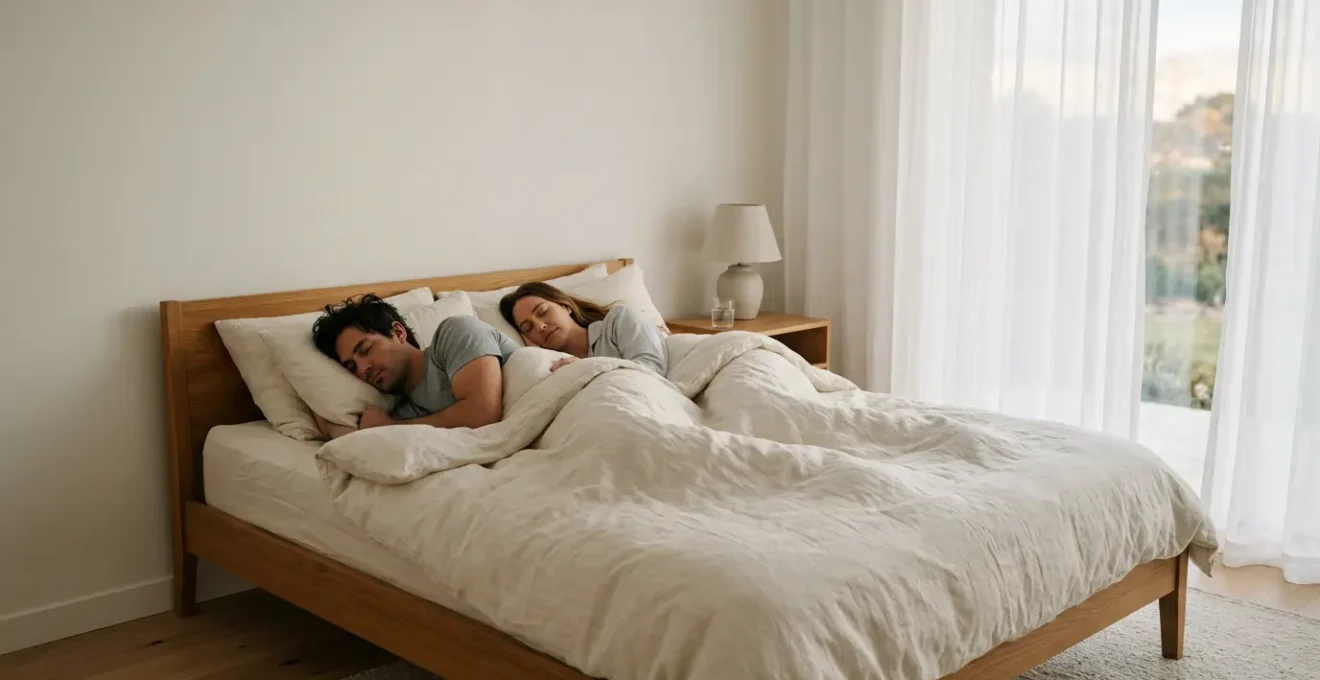
Aligning sleep schedules is not about one partner winning; it’s a diplomatic process of managing two unique body clocks to enhance both individual rest and shared intimacy.
- The core conflict often stems from “revenge bedtime procrastination” and biologically different chronotypes (night owl vs. morning lark).
- Practical solutions involve managing environmental triggers like light and temperature, not just forcing a shared bedtime.
- Reframing tools like separate beds as a strategy for mutual respect, rather than a sign of a troubled relationship, is key.
Recommendation: Start with small, consistent changes, like shifting bedtime by 15 minutes and prioritizing morning sunlight, rather than attempting a complete and immediate overhaul.
The nightly standoff is a familiar scene in countless bedrooms: one partner, the “morning lark,” is ready for sleep as the clock strikes ten, while the other, the “night owl,” feels most alive and is just hitting their stride. This difference in chronotypes isn’t a matter of discipline or willpower; it’s a biological reality. The common advice to “just compromise” or “go to bed at the same time” often fails because it ignores this fundamental difference, leading to one person lying awake in frustration and the other feeling resentful. The battle over the bedside lamp becomes a nightly symbol of a deeper disconnect.
These sleep mismatches can strain a relationship, turning the bedroom into a source of conflict instead of a sanctuary for rest and intimacy. The issue is compounded by modern pressures that lead to phenomena like “revenge bedtime procrastination,” where individuals sacrifice sleep for a sliver of personal time. But what if the solution wasn’t about forcing synchronization, but about practicing a new kind of “sleep diplomacy”? The true key lies not in a shared bedtime, but in a shared strategy. It involves understanding the science of your internal clocks and using a toolkit of environmental and behavioral adjustments that respect both partners’ needs.
This guide moves beyond the platitudes and offers a practical, solution-oriented framework. We will explore the real reasons you stay up late, how to gently shift your sleep schedule without a struggle, and how to make informed decisions about everything from room temperature to the controversial “sleep divorce.” The goal is to help you and your partner stop fighting over sleep and start working together to achieve restorative rest and a more harmonious relationship.
To navigate this complex issue, we’ve structured this guide to address each pain point systematically. The following sections provide a roadmap to help you and your partner find your unique sleep equilibrium.
Table of Contents: A Couple’s Guide to Synchronized Sleep
- Why You Stay Up Late Even When You Are Exhausted?
- How to Shift Your Bedtime 15 Minutes Earlier Every Night Successfully?
- Separate Beds vs. Earplugs: Which Solution Saves More Marriages?
- The Weekend Lie-In Mistake That Ruins Your Monday Morning
- Which Temperature Setting Will Keep You in Deep Sleep Longer?
- Why Viewing Morning Sunlight Is More Effective Than Coffee?
- Where to Charge Your Phone to Prevent Morning Doom-Scrolling?
- How to Boost Melatonin Production Naturally for Faster Sleep Onset?
Why You Stay Up Late Even When You Are Exhausted?
It’s a frustratingly common paradox: you’re bone-tired, your body is crying out for rest, yet you find yourself scrolling through your phone or watching “just one more episode” well past midnight. This isn’t necessarily a failure of self-control. It’s often a modern phenomenon known as “revenge bedtime procrastination.” This behavior is a deliberate choice to sacrifice sleep in exchange for personal leisure time that feels lacking during a packed day. It’s a way of reclaiming a sense of autonomy after long hours dedicated to work, chores, and other obligations, and it’s incredibly widespread. According to a 2025 survey, 51% of Americans engage in revenge bedtime procrastination.
The High Cost of Reclaimed Time: 300 Hours of Lost Sleep Annually
Research commissioned by Avocado Green Mattress revealed the staggering impact of this habit: revenge bedtime procrastination causes Americans to lose around 300 hours of sleep per year. A survey of over 2,000 participants found that a remarkable 96% reported choosing to stay up late for personal time, fully aware of the negative consequences the next day. The study identified the primary driver as a need for autonomy, particularly after demanding workdays that leave little room for self-directed activities. This isn’t just about being a “night owl”; it’s a psychological response to a high-pressure lifestyle.
For couples, this can be a major source of friction. The partner who is a natural early bird may interpret this behavior as a rejection or a lack of consideration. They see their partner actively choosing a screen over sleep and, by extension, over sharing a peaceful bedtime. Understanding that this procrastination is often a symptom of burnout and a desperate grab for “me-time” can shift the conversation from one of blame to one of empathy. The solution isn’t to demand an earlier bedtime, but to work together to find pockets of personal time earlier in the evening, so the need for “revenge” subsides.
How to Shift Your Bedtime 15 Minutes Earlier Every Night Successfully?
For a night owl, the idea of suddenly going to bed two hours earlier is not only daunting but biologically doomed to fail. Your body’s internal clock, or circadian rhythm, is a powerful force that can’t be reset overnight. Forcing yourself into bed when your body isn’t ready will only lead to staring at the ceiling, which creates a negative association with the bedroom. The key to success is a gradual, gentle process of circadian phase-advancing. The most effective and sustainable method is to shift your bedtime earlier by just 15 minutes at a time.
This small, manageable increment allows your body to adapt without triggering a stress response. It’s a negotiation with your biology, not a battle against it. By pairing this gradual shift with other powerful environmental cues, you can guide your body toward a new rhythm. The goal is to make the change feel so subtle that your system barely notices, until one month later, you’ve successfully moved your bedtime by a full hour without the usual struggle.
Here is a practical, week-by-week implementation guide to help you phase-advance your circadian rhythm:
- Week 1: Set your target bedtime 15 minutes earlier. Critically, expose yourself to bright morning light within 30 minutes of waking. This is the most important step to anchor your new rhythm.
- Week 2: Advance your bedtime another 15 minutes (for a 30-minute total shift). Begin dimming all evening lights after 9 PM, using amber or red-hued bulbs to prevent the suppression of melatonin.
- Week 3: Move your bedtime 15 minutes earlier again (now a 45-minute total shift). Coordinate your meal timing by having your last big meal at least 3 hours before your new target bedtime.
- Week 4: Complete the final 15-minute shift for a total of one hour. To stabilize this new rhythm, maintain a consistent wake time, even on weekends (within a 60-minute window).
A crucial recovery strategy is needed for social events or other disruptions. After a late night, return to your target bedtime immediately on the following night rather than trying to shift gradually again. One night of deviation will not reset weeks of progress if you maintain overall consistency.
Separate Beds vs. Earplugs: Which Solution Saves More Marriages?
When one partner’s severe snoring, restless legs, or drastically different schedule consistently ruins the other’s sleep, simple solutions like earplugs often feel like putting a bandage on a bullet wound. This is where the controversial but increasingly common “sleep divorce” enters the conversation. The term sounds harsh, but the practice—sleeping in separate rooms or beds—is often a pragmatic act of desperation to save both sleep and sanity. And it’s more common than you might think; according to 2025 data from the American Academy of Sleep Medicine, 31% of U.S. adults have opted for a sleep divorce at some point.
Rather than viewing it as a marital failure, it’s more productive to see it as an advanced solution on a spectrum of options. It’s a decision based on mutual respect for the fundamental need for restorative sleep. As Dr. Seema Khosla, a spokesperson for the American Academy of Sleep Medicine, points out:
It bears repeating, but a sleep divorce has more to do with mutual respect regarding the sanctity of the sleep space than with a troubled relationship.
– Dr. Seema Khosla, American Academy of Sleep Medicine spokesperson
The decision of whether to opt for separate beds or try intermediate solutions depends entirely on the specific type of sleep disturbance. A decision matrix can help couples objectively assess their situation and choose a solution that matches the problem’s severity, balancing effectiveness with the potential impact on intimacy.
| Sleep Disturbance Type | Primary Solution | Effectiveness | Intimacy Impact | Cost |
|---|---|---|---|---|
| Snoring (Mild) | Earplugs + White Noise | Moderate (60-70%) | Low – Stay Together | Low ($20-50) |
| Snoring (Severe/Sleep Apnea) | Separate Rooms + CPAP Treatment | High (85-95%) | Moderate – Requires Intentional Connection | High (Medical + Space) |
| Different Sleep Schedules | Staggered Bedtimes + Cuddle Time | High (80-90%) | Low – Quality Over Quantity | None |
| Temperature Preferences | Dual-Zone Mattress Pad / Two Duvets | High (85-90%) | None – Physical Proximity Maintained | Moderate ($200-800) |
| Movement/Restlessness | Separate Blankets + Motion-Isolating Mattress | Moderate-High (70-85%) | Low – Surface Contact Reduced | Moderate-High ($500-2000) |
Ultimately, a “sleep divorce” only negatively impacts intimacy if the couple allows it to. By intentionally scheduling “cuddle time” or other forms of physical connection before retreating to separate sleep spaces, many couples find their relationship improves. They are better rested, less resentful, and the quality of their time together increases, even if the quantity of shared sleeping hours decreases.
The Weekend Lie-In Mistake That Ruins Your Monday Morning
After a grueling week of early alarms, the temptation to “catch up” on sleep during the weekend is almost irresistible. Sleeping in until 10 or 11 a.m. on Saturday and Sunday feels like a well-deserved reward. However, this common habit is one of the biggest saboteurs of a consistent sleep schedule, a phenomenon scientists call “social jetlag.” This occurs when there’s a significant discrepancy between your sleep schedule on workdays and your schedule on free days. You are, in effect, giving your body jet lag every single weekend without ever boarding a plane.
When you sleep in for several hours, you shift your internal body clock later. Your body starts to think that the later wake-up time is the new normal. Then, on Sunday night, you find yourself unable to fall asleep at your usual “work night” bedtime because your body is still on its weekend time zone. The result is a groggy, difficult Monday morning where you feel unrested and out of sync, often reaching for extra coffee just to function. This effect is not trivial; a 2025 study of nearly 20,000 students found a mean social jetlag of 1 hour and 53 minutes, which is enough to significantly disrupt performance and mood at the start of the week.
For couples with different chronotypes, social jetlag creates another layer of complexity. The night owl may push their weekend schedule even later, further desynchronizing from their early-bird partner. This can mean less quality time together during the weekend daylight hours and an even more difficult reset on Sunday evening. The key to mitigating social jetlag isn’t to eliminate weekend relaxation but to manage the variance. The expert consensus recommends keeping your weekend wake-up time within 60 to 90 minutes of your weekday wake-up time. This allows for some extra rest without completely derailing your circadian rhythm, making the transition back to the workweek far less jarring for both partners.
Which Temperature Setting Will Keep You in Deep Sleep Longer?
The battle over the thermostat is a classic couple’s conflict, but it’s more than a matter of comfort—it’s a critical factor in sleep quality. Your body’s core temperature needs to drop by a couple of degrees to initiate and maintain deep, restorative sleep. If the bedroom is too warm, it interferes with this natural thermoregulation process, leading to more nighttime awakenings and less time spent in the crucial stages of deep and REM sleep. While personal preference plays a role, science points to a clear optimal range.
Research consistently shows that a cool room is better for sleep. While the exact temperature can vary slightly from person to person, the general consensus is a range between 60-67°F (15-19°C). Going much warmer can be detrimental; a 2023 longitudinal study on community-dwelling older adults found that sleep was most efficient between 20-25°C (68-77°F), with a notable 5-10% drop in sleep efficiency when the ambient temperature increased from 25°C to 30°C. This confirms that keeping the bedroom on the cooler side is a powerful tool for improving sleep architecture for both partners.
So, how do you find a compromise when one partner is always cold and the other is always hot? The solution isn’t to fight over a single thermostat setting. Instead, the most effective approach is to set the room to a baseline cool temperature and then use individual solutions to adjust for personal comfort. This strategy of “controlling your microclimate” allows both partners to win. The partner who runs hot benefits from the cool ambient air, while the partner who runs cold can add layers as needed. This simple reframing moves the focus from conflict to cooperative problem-solving.
Your Action Plan: The Temperature Compromise Toolkit
- Set the Baseline: Agree to set the bedroom thermostat between 60-67°F (15-19°C) as the non-negotiable room temperature. All adjustments happen at the individual level.
- Implement the Scandinavian Method: Use two separate duvets or blankets, one for each partner. This allows each person to choose the weight and warmth they prefer without affecting the other.
- Invest in Climate Control: Consider a dual-zone mattress cooling/heating pad. These allow each side of the bed to be set to a specific temperature, providing the ultimate personalized comfort.
- Choose Breathable Fabrics: Use sleepwear and sheets made from natural, moisture-wicking fibers like cotton, bamboo, or linen. These materials help with individual thermoregulation, keeping you dry and comfortable.
- Trigger the Temperature Drop: Both partners can take a warm bath or shower 90 minutes before bed. This raises body temperature, and the subsequent cool-down period signals to the brain that it’s time for sleep.
Why Viewing Morning Sunlight Is More Effective Than Coffee?
For many, the morning doesn’t truly begin until after the first cup of coffee. While caffeine provides a welcome jolt of alertness, it’s a temporary fix that works by blocking sleep-promoting chemicals in your brain. A far more powerful and fundamental tool for setting your entire day’s energy and your night’s sleep is something much simpler: morning sunlight. When light, particularly the blue-spectrum light abundant in morning sun, enters your eyes, it sends a direct and powerful signal to a master clock in your brain called the suprachiasmatic nucleus (SCN).
This light exposure does two critical things. First, it triggers the timely shutdown of melatonin production, the hormone that makes you sleepy. Second, it starts a countdown for the release of cortisol, a hormone that promotes wakefulness and alertness, which should peak about 30-60 minutes after you wake up. This process anchors your entire 24-hour circadian rhythm. Getting 10 to 30 minutes of sunlight within the first hour of waking is the single most effective thing you can do to tell your body, “The day has begun.” It solidifies your wake-up time and, in doing so, helps regulate your sleep-onset time later that night. It’s a proactive strategy, whereas coffee is a reactive one.
For couples trying to align their sleep, this morning ritual is a game-changer. It’s a non-negotiable activity you can do together, even if your wake-up times are slightly different. The early bird can get their light exposure first, and the night owl can do the same upon waking an hour later. This shared principle helps to gently nudge both of your body clocks into closer alignment over time. This is especially important given that partners have a significant impact on each other’s sleep patterns. Research has shown that couples causally influence each other’s sleep duration, wake time, and even restlessness. As lead author Dr. Rebecca C Richmond of the University of Bristol noted, “This highlights the importance of considering both partners in sleep health interventions.” Morning light is a perfect example of such an intervention.
Where to Charge Your Phone to Prevent Morning Doom-Scrolling?
The habit is deeply ingrained: the alarm goes off, you reach for your phone to turn it off, and the next thing you know, twenty minutes have vanished into a vortex of emails, news headlines, and social media feeds. This “doom-scrolling” or “waking-scrolling” habit starts your day with a flood of cortisol-spiking information and a sense of reactive stress before your feet even touch the floor. It also erodes the precious morning time that could be used for more positive routines, like getting sunlight or connecting with your partner. The phone’s role as our primary alarm clock has made it an unwelcome bedfellow and the primary saboteur of a peaceful morning.
This problem is particularly acute for younger generations. A 2025 survey by Amerisleep found that for Gen Z, social media is a major sleep thief, with 49% citing TikTok as their biggest culprit. This same group’s average bedtime is 12:30 a.m., highlighting a powerful link between device use and delayed sleep schedules. The only truly effective solution is to create physical distance. The phone should not be in the bedroom at night. To overcome the common “I need it for my alarm” excuse, a simple but radical solution is required: create a designated family charging station outside of all bedrooms.
This strategy works because it removes the temptation entirely. It creates a clear, physical boundary between your connected life and your personal sanctuary. Here is a simple guide to setting one up:
- Designate a Neutral Zone: Choose a common area like the kitchen counter or a living room shelf to be the official household charging station. This rule must apply to everyone.
- Buy a Physical Alarm Clock: Invest in a simple, non-illuminated alarm clock for each bedroom. This single-task device eliminates the primary excuse for keeping a phone at the bedside.
- Configure “Do Not Disturb” Mode: Before plugging in phones at the station, set them to a strict “Do Not Disturb” or “Focus” mode that allows calls only from true emergency contacts. Block all other notifications.
- Establish a Digital Curfew: Make it a household rule to place all devices at the charging station at least one hour before the earliest partner’s target bedtime.
- Create a Replacement Ritual: Fill the newly created phone-free time with a positive evening activity, such as reading a physical book, gentle stretching, or simply talking with your partner.
By making the bedroom a phone-free zone, you reclaim both your evening wind-down period and your morning wake-up routine. It’s a powerful act of sleep diplomacy that benefits both partners, reducing late-night distractions and preventing morning stress.
Key Takeaways
- Reframe your goal from a “shared bedtime” to achieving “high-quality individual sleep” and “dedicated couple time,” which may occur at different times.
- Morning sunlight exposure within 30 minutes of waking is the most powerful, non-negotiable tool for synchronizing your body clocks.
- Before considering a “sleep divorce,” use a solutions-matrix approach to tackle specific issues like temperature, noise, or movement. A sleep divorce itself is a valid, non-judgmental option for severe cases.
How to Boost Melatonin Production Naturally for Faster Sleep Onset?
Melatonin is the “hormone of darkness,” the chemical signal that tells your body it’s time to sleep. Your brain begins producing it as light fades, but modern life—with its bright screens and overhead lighting—can severely disrupt this natural process. While supplements are an option, they can lead to dependency and grogginess. A more sustainable and holistic approach is to support your body’s own melatonin production through your evening environment and nutrition. Two of the most powerful levers you have are light management and strategic snacking.
As discussed, dimming the lights and avoiding the blue light from screens in the 1-2 hours before bed is critical. This allows your brain’s melatonin factory to start its work on time. In addition to light control, certain foods contain the building blocks or even small amounts of melatonin itself, which can help facilitate faster sleep onset. These foods are rich in compounds like tryptophan (a precursor to both serotonin and melatonin), magnesium (a muscle relaxant), and natural melatonin. A small, strategically timed snack can be the final nudge your body needs to wind down.
The ideal snack and timing can even be tailored to your specific chronotype. An early bird going to bed at 9:30 PM will have a different snacking schedule than a night owl aiming for an 11:30 PM bedtime. This approach allows both partners to support their own rhythm while sharing the same nutritional principles.
| Chronotype | Evening Snack (2-3h before bed) | Melatonin-Boosting Component | Serving Size | Timing Strategy |
|---|---|---|---|---|
| Early Bird (Goes to bed 9-10 PM) | Tart cherry juice + handful of walnuts | Natural melatonin + tryptophan + omega-3 | 1 cup juice + 1 oz walnuts | 7-8 PM snack |
| Night Owl (Goes to bed 11 PM-12 AM) | Banana with almond butter | Tryptophan + magnesium + vitamin B6 | 1 medium banana + 1 tbsp almond butter | 9-10 PM snack |
| Intermediate (Goes to bed 10-11 PM) | Oatmeal with milk and kiwi | Complex carbs + calcium + serotonin precursors | 1/2 cup oats + 1/2 cup milk + 1 kiwi | 8-9 PM snack |
| Variable Schedule Partners | Chamomile tea + small handful of pistachios | Apigenin antioxidant + melatonin + protein | 1 cup tea + 1 oz pistachios | Flexible 2-3h before individual bedtime |
By combining a dark or dimly lit evening environment with a small, smart snack, you create the ideal conditions for robust melatonin production. This natural approach helps you fall asleep faster and can improve the overall quality of your rest, making it a cornerstone of any couple’s shared sleep strategy.
Start tonight by choosing one small strategy from this guide to implement together. Transforming your bedtime from a battleground into a shared sanctuary for rest begins not with a grand gesture, but with a single, diplomatic step forward.