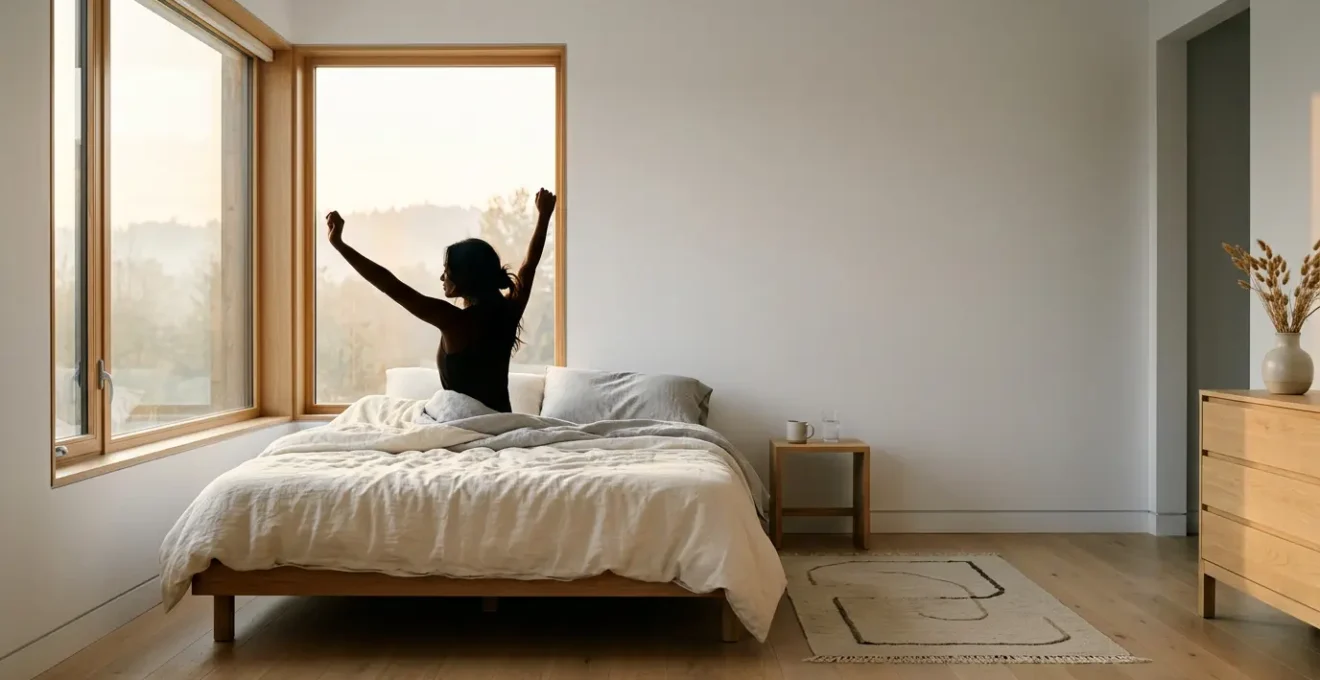
Waking up energized isn’t about willpower or drinking more coffee. It’s about scientific entrainment. The key is to strategically send powerful signals—called zeitgebers—to both your brain’s master clock and your body’s peripheral clocks. By precisely timing your exposure to light and your intake of food, you can deliberately phase-shift your internal biology to align with your demanding schedule, effectively overcoming social jetlag and making alarm-free mornings an achievable reality.
For the committed night owl forced to live in an early bird’s world, the morning is a constant battle. That groggy, disoriented feeling, known as sleep inertia, isn’t a personal failing; it’s a physiological symptom of “social jetlag”—a conflict between your innate biological clock and the rigid demands of a 9-to-5 schedule. The conventional advice often feels inadequate or dismissive: “just go to bed earlier” or “have a strong coffee.” These are superficial fixes that ignore the complex, interconnected system of clocks ticking away in every cell of your body.
This struggle stems from a desynchronization between your master clock, located in the suprachiasmatic nucleus (SCN) of your brain, and the myriad peripheral clocks in your organs, like your liver and muscles. While coffee can mask the fatigue, it does nothing to align these systems. The real solution lies not in fighting your biology, but in skillfully guiding it. It requires a deeper understanding of the powerful environmental cues, or zeitgebers, that our bodies are hardwired to obey.
But what if the most potent tool for this wasn’t a pill or a beverage, but a precise, tactical application of light and meal timing? The true key to waking up energized is to stop treating the symptom (tiredness) and start addressing the root cause: circadian misalignment. This guide moves beyond simplistic sleep hygiene to provide a tactical, evidence-based framework for manipulating these zeitgebers. We will explore how to use sunlight as a potent hormonal trigger, why your evening lighting choices matter more than you think, and how the timing of your first meal can anchor your entire metabolic rhythm for the day.
This article provides a scientific yet practical roadmap to entrain your internal clocks. By following these evidence-based strategies, you can learn to work with your unique chronobiology to finally wake up feeling alert, focused, and ready for the day, without depending on an alarm clock.
Summary: Your Guide to Mastering Biological Time
- Why Viewing Morning Sunlight Is More Effective Than Coffee?
- How to Use Blue Light Blocking Glasses Correctly in the Evening?
- Weekend Camping vs. Melatonin: Which Resets Your Clock Faster?
- The Late-Night Snack That Desynchronizes Your Liver Clock
- When to Eat Your First Meal to Beat Jet Lag Instantly?
- When to Schedule Deep Work Based on Your Unique Biological Rhythm?
- Why Your “Warm” LED Bulbs Might Still Be Suppressing Melatonin?
- How to Align Your Sleep Patterns With Your Partner’s Without Losing Rest?
Why Viewing Morning Sunlight Is More Effective Than Coffee?
The first cup of coffee is a near-universal ritual for shaking off morning grogginess, but it’s a temporary patch, not a fundamental solution. Coffee acts as an adenosine antagonist, blocking the sleep-pressure signals in your brain. Sunlight, however, initiates a powerful and natural cascade of hormones that actively promotes wakefulness and aligns your master clock. This process begins with the Cortisol Awakening Response (CAR), a natural surge in the stress hormone cortisol that occurs within 30-60 minutes of waking. This is not the chronic, negative stress cortisol, but a vital signal that energizes the body and mind for the day ahead.
Exposing your eyes to direct, low-angle sunlight shortly after waking is the most powerful zeitgeber for triggering a robust CAR. As Dr. Andrew Huberman, a neuroscientist at Stanford University, explains, this specific light cue is a cornerstone of circadian health. As he states in his work on neural health:
Viewing sunlight in the morning causes ~50% increase in circulating cortisol, epinephrine and dopamine. These leverage healthy increases in energy, immune system function and mood.
– Andrew D. Huberman, Ph.D., Huberman Lab Newsletter
This hormonal cocktail is far more comprehensive than the singular effect of caffeine. The increase in dopamine enhances motivation and focus, while epinephrine boosts alertness. In fact, research shows that participants exposed to bright morning light experienced 20-40% higher peak cortisol levels compared to those in dim light. This effect is achieved through specialized cells in your eyes called intrinsically photosensitive retinal ganglion cells (ipRGCs), which communicate directly with your brain’s master clock. A 10-30 minute walk outside, even on a cloudy day, provides a signal far stronger than any indoor lighting, effectively setting your daily timer and promoting a natural, sustained energy that coffee can’t replicate.
How to Use Blue Light Blocking Glasses Correctly in the Evening?
Just as morning light sets your wake-up timer, avoiding specific light wavelengths in the evening is critical for allowing your brain to prepare for sleep. The enemy here is not light itself, but the high-energy blue spectrum light that dominates our screens and modern LED bulbs. This light is particularly effective at suppressing the production of melatonin, the hormone that signals darkness and initiates sleep. For a night owl already fighting to fall asleep earlier, evening blue light exposure is a significant saboteur.
This is where blue light blocking glasses become a tactical tool, but not all are created equal. The key to their effectiveness lies in their ability to filter the precise wavelengths that most strongly inhibit melatonin. The ipRGCs in our eyes, the same cells that respond to morning sun, are most sensitive to a specific band of light. Crucially, scientific research identifies that the 460-480 nm wavelength range is the peak for melatonin suppression. Therefore, effective glasses must have dark amber or red lenses that can block nearly 100% of this specific blue-turquoise spectrum. Glasses with clear or light-yellow lenses are largely ineffective for circadian management.

The protocol is simple but requires consistency. Wear these glasses for the 2-3 hours leading up to your desired bedtime. This creates a “virtual darkness” for your brain, allowing melatonin to rise naturally, even while you read on a tablet or watch television. This single habit can significantly reduce the time it takes to fall asleep and improve sleep quality, helping you shift your sleep schedule forward without the groggy side effects of sleep aids. It’s a proactive measure to manage your light environment, a cornerstone of circadian health.
Weekend Camping vs. Melatonin: Which Resets Your Clock Faster?
For those struggling with severe social jetlag, the idea of a “circadian reset” is highly appealing. Two common strategies emerge: taking a melatonin supplement or attempting a more natural reset. While melatonin can help induce sleepiness, it’s often a blunt instrument. A far more powerful and holistic method is to immerse oneself in a natural light-dark cycle. The most dramatic demonstration of this is a simple weekend camping trip.
Case Study: The University of Colorado Boulder Wilderness Camping Reset
Researchers at CU Boulder conducted a fascinating experiment to quantify the power of natural light. They sent volunteers camping for a weekend, removing all artificial light sources like headlamps and phones. The results were staggering. Campers were exposed to about four times more intense light during the day compared to their typical indoor lives. In just two days, the timing of their melatonin onset shifted an average of 1.4 hours earlier. This weekend reset achieved 69% of the total circadian shift that a previous study had found after a full week of camping, demonstrating the rapid and profound effect of aligning with the sun’s natural rhythm. This natural entrainment resets not just one hormone, but the entire symphony of circadian-driven processes in the body.
This rapid phase shift starkly contrasts with the effects of melatonin supplementation. While a low-dose melatonin pill taken in the afternoon can help advance the sleep phase, its effects can be variable and it doesn’t synchronize the full array of bodily clocks in the same way. The camping experiment reveals that our bodies are exquisitely sensitive and responsive to their ancestral environment. The combination of bright, full-spectrum daylight and the profound darkness of a night without artificial light is a powerful zeitgeber that oral melatonin cannot fully mimic.
Even if a wilderness trip isn’t feasible, the lesson is clear. Maximizing daytime sun exposure and minimizing evening artificial light—perhaps by simulating a “camping at home” weekend—can produce a significant reset. As the study by University of Colorado professor Ken Wright demonstrated, a 1.4 hours earlier melatonin shift in just 48 hours is possible through natural light exposure alone. This makes it a faster and more comprehensive reset mechanism than relying solely on a supplement.
The Late-Night Snack That Desynchronizes Your Liver Clock
While light is the master zeitgeber for the brain’s SCN, food timing is the dominant cue for our peripheral clocks. These are the internal timekeepers located in our organs, including the liver, pancreas, and gut. For optimal health, these peripheral clocks must be synchronized with the master clock. When they are not, we experience internal desynchrony, which can lead to metabolic issues, digestive problems, and further disrupt our sleep-wake cycle. The most common cause of this desynchrony is late-night eating.
When you eat a meal, particularly one high in carbohydrates or fats, late in the evening, you are sending a powerful “daytime” signal to your liver and digestive system. This occurs at the very moment your brain’s master clock is preparing the body for the fasting and repair processes of the night. This conflicting information effectively tells your liver it’s time to work while your brain says it’s time to rest. This mismatch is a core reason why night owls who eat late often struggle with both sleep quality and morning energy, regardless of their light exposure habits.

The biological impact is significant. As research published in Frontiers in Endocrinology confirms that late-night eating leads to desynchronization between the central and peripheral clocks. This can impair glucose tolerance, increase insulin resistance, and disrupt the metabolic rhythm that should support restorative sleep. To entrain your body effectively, you must align your eating window with your desired daytime. This means aiming to consume your last meal at least 3-4 hours before your target bedtime. This fasting period gives your peripheral clocks a clear “nighttime” signal, allowing them to synchronize with the master clock and support, rather than fight, your sleep.
When to Eat Your First Meal to Beat Jet Lag Instantly?
The principle of using food as a zeitgeber is most powerfully demonstrated in the context of jet lag, the most acute form of circadian disruption. When you travel across time zones, your internal master clock is completely out of sync with the new local time. While light exposure is crucial for resetting the SCN, anchoring your peripheral clocks with a strategically timed meal can dramatically accelerate your adaptation. The key is not just *what* you eat, but *when* you break your fast.
A highly effective strategy is the “Fast-and-Feast” protocol. This involves a period of fasting (typically 12-16 hours) that culminates in eating your first meal at the normal breakfast time of your destination. This long fast helps to reset the food-entrainable oscillators in your body. When you finally eat, that first meal acts as a powerful signal, telling your liver, gut, and other metabolic clocks, “This is the new morning.” Combining this with exposure to morning sunlight at your destination creates a dual-pronged attack, sending a coherent “wake-up” signal to both your central and peripheral clocks simultaneously.
This method leverages the body’s innate survival mechanisms. After a period of fasting, the system is highly sensitive to the signal of first food. By intentionally timing this signal, you can hijack this sensitivity to force a rapid circadian reset. It’s a way to tell your entire body, in no uncertain terms, where the new “day” begins.
Your Action Plan: The Fast-and-Feast Protocol for Time Zone Shifting
- Begin fasting 12-16 hours before your destination’s breakfast time (this can start during your flight).
- Upon arrival, eat your first substantial meal at the normal breakfast time of your destination (e.g., 8 AM local time).
- Ensure this meal is high in protein and healthy fats to promote alertness and stabilize blood sugar.
- Combine your first meal with morning light exposure at your destination for a dual zeitgeber effect.
- Maintain a regular meal schedule aligned with your destination’s time for the next 2-3 days to fully anchor the circadian reset.
When to Schedule Deep Work Based on Your Unique Biological Rhythm?
Productivity is not just about time management; it’s about energy management. And our energy, focus, and cognitive abilities are not constant throughout the day—they fluctuate according to our underlying circadian rhythm. A “night owl” (late chronotype) trying to force deep, analytical work at 9 AM is working against their own biology, a time when their cortisol levels are just beginning to rise and their core body temperature is still low. Understanding and respecting your chronotype is the key to scheduling your day for maximum effectiveness, especially when your schedule feels at odds with your nature.
Morning larks experience their peak alertness and cognitive function in the morning, shortly after their cortisol awakening response. For them, the 9-11 AM window is ideal for tasks requiring intense concentration and analytical thought. Night owls, however, are a different story. Their biological peak often occurs much later in the day. Forcing deep work in the morning can feel like wading through mental molasses. Instead, a night owl’s prime window for deep, focused work is typically in the mid-to-late afternoon (e.g., 3-6 PM) or even a secondary peak in the evening.
The strategy, therefore, is to structure your workday around these biological realities. For the night owl on an early-bird schedule, the morning might be better suited for administrative tasks, email correspondence, or collaborative meetings that require less raw cognitive horsepower. The precious afternoon hours should be fiercely protected for the deep work that truly moves the needle. This approach, known as chronotype-based task scheduling, allows you to align your most demanding tasks with your periods of peak biological performance.
| Time Period | Morning Larks (Early Chronotype) | Night Owls (Late Chronotype) |
|---|---|---|
| Peak Cortisol Window | 7-9 AM (1-2 hours post-wake) | 10 AM-12 PM (1-3 hours post-wake) |
| Optimal Deep Work | 9-11 AM | 3-6 PM |
| Afternoon Trough (2-4 PM) | Creative tasks, brainstorming, meetings | Administrative tasks, light work |
| Evening Schedule | Wind down after 7 PM | Secondary focus period 7-10 PM |
| Sleep Timing | 10 PM-6 AM | 12 AM-8 AM |
Why Your “Warm” LED Bulbs Might Still Be Suppressing Melatonin?
Many people, aware of the disruptive effects of blue light, have switched their evening household lighting to “warm” or “soft white” LED bulbs. This seems like a logical step, as the yellowish hue feels less harsh and more relaxing. However, this is a dangerously misleading simplification. The perceived “warmth” of a light source, measured in Kelvin (K), does not tell the whole story about its biological impact. A bulb labeled 2700K or 3000K can still be a potent source of melatonin-suppressing blue light.
The issue lies in the technology of how white LEDs produce light. Most “warm white” LEDs are fundamentally blue LEDs coated with a yellow phosphor. While the phosphor converts some of the blue light into longer wavelengths (yellow, red), a significant amount of the underlying blue light, particularly in the critical 460-480 nm range, still passes through. Your brain may perceive the overall light as warm and cozy, but your ipRGCs are still detecting that hidden spike of blue light and signaling to your SCN that it’s still daytime.
Case Study: The Hidden Blue Spike in Warm LEDs
A revealing study on the effects of different LED color temperatures highlights this very issue. Researchers analyzed the spectral output of various commercial LED bulbs and found that even those with a warm color temperature (e.g., 3,500K) contained a distinct peak in the blue wavelength spectrum, precisely where the circadian system is most sensitive. The study demonstrated that these photoreceptors in the eye respond to this specific wavelength component, influencing melatonin and cortisol secretion, regardless of the light’s overall perceived color. This confirms that color temperature alone is an insufficient metric for judging a light’s circadian impact. A truly “circadian-friendly” light source for the evening must be not just warm, but certifiably low or absent in blue wavelengths.
This means that for true light hygiene in the evening, you must go beyond simply choosing a “warm” bulb. The only guaranteed solutions are to use dedicated blue-free amber or red lights, or to wear certified blue-blocking glasses as a final line of defense. Relying on standard warm LEDs is a common mistake that can subtly sabotage your efforts to phase-shift your sleep schedule forward.
Key Takeaways
- Morning sunlight is a hormonal trigger for wakefulness (via cortisol), making it biologically more powerful than a stimulant like coffee.
- Effective circadian entrainment requires managing two primary zeitgebers: the timing of bright light exposure and the timing of food intake to align both master and peripheral clocks.
- Technology for circadian management (e.g., blue-blocking glasses, “warm” bulbs) must be chosen based on its ability to filter specific wavelengths (460-480nm), not on perceived color or marketing claims.
How to Align Your Sleep Patterns With Your Partner’s Without Losing Rest?
For a night owl, one of the most significant challenges to maintaining a consistent sleep schedule is sharing a bed with a partner of a different chronotype—a common scenario known as a “lark-owl” relationship. The lark’s desire to go to bed at 10 PM can conflict with the owl’s natural rhythm, creating tension and leading to compromised rest for both. Insisting one partner conform to the other’s schedule is rarely sustainable and often breeds resentment. A more practical and empathetic approach is needed, one that prioritizes both shared time and individual biological needs.
The solution lies in a strategy of compromise and synchronization of non-sleep zeitgebers. The goal is not to force identical sleep times, but to create a core, overlapping sleep window while allowing flexibility on either end. This respects each person’s chronotype while ensuring a period of shared rest. This core principle is the foundation of the “Anchor Sleep Method,” a tactical approach for couples with differing sleep schedules.
Beyond sleep timing, synchronizing other daily routines can powerfully entrain both partners’ rhythms closer together. Eating dinner at the same time each evening, getting morning sunlight exposure together, and creating a shared wind-down ritual (like reading or talking, with the early sleeper wearing a sleep mask) can create powerful social zeitgebers. These shared activities signal to both bodies that they are on a similar team, even if their sleep onset and offset times differ by an hour or two. This fosters connection while acknowledging and respecting biological diversity.
Your Action Plan: The Anchor Sleep Method for Couples
- Identify a non-negotiable 4-5 hour core sleep window that both partners can share (e.g., 1 AM to 6 AM for a lark/owl pair).
- Allow chronotype-aligned flexibility: the ‘lark’ partner can go to bed 1-2 hours earlier, while the ‘owl’ partner stays up 1-2 hours later.
- Synchronize non-sleep zeitgebers: eat dinner together at a consistent time and get morning sunlight exposure together.
- Create split-environment bedroom solutions, such as individual reading lights, sleep masks for the early sleeper, and a white noise machine.
- Consider dual-zone temperature-controlled bedding to accommodate different thermal comfort needs during the shared sleep hours.
Mastering your circadian rhythm is an ongoing practice, not a one-time fix. Begin by implementing the most impactful and accessible strategy for you—viewing morning sunlight for 15 minutes—and observe the powerful shift in your energy and mood. From there, you can layer in other protocols to build a robust, resilient biological clock that serves you, even when your schedule doesn’t.